Follow Wild West Extravaganza on iHeartRadio - https://ihr.fm/3b8ouFA
Follow on Apple Podcasts - https://apple.co/3zOHGCH
Follow everywhere else - https://bit.ly/3zOnJfe
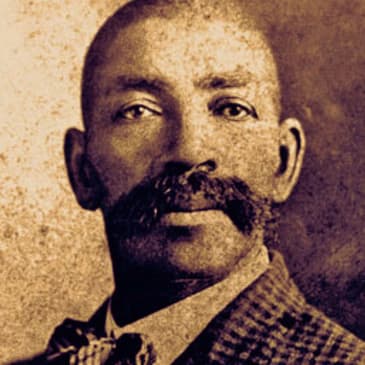
Described in the papers of his day as a holy terror and one of the greatest manhunters to ever grace Indian Territory, Bass Reeves served as a deputy U.S. Marshal for over three decades; routinely traveling into no man’s land and returning with wagonloads of prisoners. With over 3,000 arrests and over a dozen kills to his name, Reeves was not only one of the most effective lawmen of the Old West but also one of the most deadly. But who was Bass Reeves really? What kind of man was he? Where’d he come from? How does a mere mortal grow such an amazing mustache? And did he really inspire the Lone Ranger?
Check out the website for more true tales from the Old West https://www.wildwestextra.com/
Email me! https://www.wildwestextra.com/contact/
Snapper’s Antique Firearms | 45 Colt in a 73 Winchester 44-40 - https://youtu.be/xa9WMMlSWlU?si=KuXpcq1q-aQUs57b
Black Gun Silver Star by Art T. Burton - https://www.amazon.com/dp/1496233425?linkCode=ssc&tag=onamzjoshta02-20&creativeASIN=1496233425&asc_item-id=amzn1.ideas.YEHGNY7KFAU7&ref_=aip_sf_list_spv_ofs_mixed_d_asin
Free Newsletter! https://wildwestjosh.substack.com/
~~~~~~~~~~~~~~~~~~~~~~~~~~~~~
You can find Indie Drop-In at https://indiedropin.com
Help Indie Drop-In support indie creators by buying us a coffee!
https://buymeacoffee.com/indiedropin
Brands can advertise on Indie Drop-In using Patreon
https://patreon.com/indiedropin
Twitter: https://twitter.com/indiedropin
Instagram: https://instagram.com/indiedropin
Facebook: https://facebook.com/indiedropin
Any advertising found in this episode is inserted by Indie Drop-In and not endorsed by the Creator.
If you would like to have your show featured, go to http://indiedropin.com/creators
~~~~~~
]]>
[00:00:00] Listener discretion is advised. Hello and welcome to True Crime, the podcast that helps you find new, emerging, and undiscovered true crime podcasts. I'm Greg, the host and curator of True Crime. Today's episode is from The Wild West Extravaganza.
[00:00:17] The Wild West Extravaganza are true tales from the Old West. If you like today's episode, make sure to check out the episode description for links to subscribe. All right, let's get this show started.
[00:00:30] Back in the day, there was this giant of a black marshal working out of Indian territory by the name of Bass Reeves. Chances are if Bass was on your trail, he'd find you.
[00:00:39] And the smartest thing a man could do at that point was just surrender and hope for a good lawyer. Ah, but outlaws ain't the most intelligent to creatures. And they damn sure ain't invincible. Just ask noted killer and horse thief Tom Story.
[00:00:53] Bass tracked Story all the way down to the Red and caught him trying to flee back into Texas with a pair of stolen mules. Little Reeves ordered Tom to throw his hands up and well, I guess Story was feeling lucky.
[00:01:04] He went for his pistol and according to Bass, quote, right then and there, Tom Story committed suicide. End quote. Make no mistake about it, the exploits of Bass Reeves are legendary. Described in the papers of his day as a holy terror and one of the greatest man
[00:01:19] hunters to ever grace the territory, Bass served as a deputy United States Marshal for over three decades, routinely traveling into no man's land and returning with wagon loads of prisoners. But not everyone came on their own accord.
[00:01:32] There was always a few like Tom Story and Bass Reeves left many an unmarked grave in his wake. Said to have arrested over 3,000 criminals and killed over a dozen men in the line of
[00:01:43] duty, Reeves was not only one of the most effective lawmen of the Old West but also one of the most deadly. To quote historian Art Burton, To me Bass Reeves is the greatest frontier hero in American history. Bar none. I don't know who you could compare him to.
[00:01:59] This guy walked into the valley of death every day for 32 years and came out alive. But who was Bass Reeves? Really? What kind of a man was he? Where'd he come from? Did he really inspire the Lone Ranger?
[00:02:12] And how the hell does a mere mortal grow such an amazing mustache? My name's Josh and you're listening to the Wild West Extravaganza. Bass Reeves was born into slavery in Crawford County, Arkansas in the summer of 1838.
[00:02:36] He and his family were owned by farmer William S Reeves who in 1846 moved everyone down to Grayson County, Texas just south of the Red River. Just there, young Bass worked out in the fields alongside his parents as a water boy until
[00:02:51] he grew older and was given the additional duties of caring for horses and assisting the blacksmith. And somewhere in his teens, Bass was selected to be his quote unquote master's companion, his master being George Reeves, the son of the aforementioned William.
[00:03:06] This was a much more cushy job compared to that of your average slave laboring out in the fields but making no mistake about it. Bass was still considered not much more than a piece of property.
[00:03:16] As a so-called companion, he would serve as a mixture of George's coachmen, valet, butler and even bodyguard. Worth pointing out that George Reeves at this time was both tax collector and sheriff for Grayson County. Slave status notwithstanding one can only assume that this was quite the learning
[00:03:33] experience for young Bass. Speaking of learning, it was also around this period that Bass asked George for permission to learn how to read. This request was denied and instead George allowed Bass to learn how to handle a firearm. And well, the rest is history.
[00:03:48] It really goes to show the power of an education though. They were more scared of a black man who could read than they were of one wielding a gun. And I think that's saying something.
[00:03:57] As it turns out Bass got so damn good with them guns that George routinely entered the young man into shooting contests, profiting from the prize money while doing so. Legend has it that years later Bass would be banned from participating in
[00:04:09] turkey shoots just as an attempt to let others have a fighting chance. Now when the Civil War broke out, George Reeves was commissioned as a colonel in the 11th Texas Cavalry. And when the regiment rode off to fight the Yankees, Bass was right there with
[00:04:22] them in the capacity of a body servant. A body servant by the way is just a term used to describe the slaves who serve soldiers in the field. Oftentimes taking care of their horses and gear and just handling camp chores.
[00:04:35] This is a long tradition and even George Washington had a body servant during the American Revolution. I have not seen the movie Hell on the Border based on the life of Bass Reeves so I don't know how they portray this particular period.
[00:04:47] And as of this recording, the new miniseries Lawman, Bass Reeves, has not yet been released. That said in the trailer for Lawman, there's a split second there where it looks like Bass is dressed in Confederate gray and riding into battle.
[00:05:01] So I'm not really sure how they're gonna play it but I will say from a historical perspective, there is no indication that Bass ever fought on the side of the rebels or even accompanied George into the thick of things.
[00:05:12] Matter of fact, there's not a whole hell of a lot known about this point in Bass' life. Up to and including how long he rode with the 11th Texas. All we know for certain is that at some point Bass made a run for it,
[00:05:24] fleeing bondage and finding refuge over in Indian territory. There are different stories as to how this all went down but one of the most prevalent is that Bass and George got into an altercation while playing cards and things turned physical.
[00:05:37] Years later, Bass' own daughter, Alice, would state that Bass quote, laid him, George, out cold with his fist and then made a run for the Indian territory with the hue and cry of runaway inward hounding him up until emancipation. End quote.
[00:05:52] As for where and when this happened, nobody knows for sure. Bass himself claimed to have been with the Confederates at the battles of Pea Ridge, Chickamaugua and Missionary Ridge and even said that he personally witnessed the death of General Ben McCulloch in March of 1862.
[00:06:08] This doesn't necessarily jive with the stories passed down through the family though. Bass' great-nephew, the honorable Judge Paul Brady, asserted that Bass defected and fought against the Confederacy alongside the Creek and Seminole in the battle of Chustin Law which occurred very early in the war in December of 1861.
[00:06:27] Still others think that Bass served as a sergeant in the Union Army but that has not yet been verified. Like I said man, this period of the future lawman's life is murky at best when it comes to particulars.
[00:06:38] For a fact, Bass departed Texas with the 11th Cav and that regimen did engage abolitionist forces in present day Oklahoma. And yeah, somewhere along the line, Bass made his big break for freedom. It's believed by most that he hid out in the territory for a spell likely
[00:06:53] in very close proximity with the Creek and Seminole peoples as he would learn to speak their language and pick up more than a few indigenous skills that would serve him well in the years to come.
[00:07:02] And somewhere along the way, Bass got hitched to a lady by the name of Ginny. By June of 1870 things clear up a bit and we find Bass now using the surname of his former owner Reeves, once more living in the place of his birth,
[00:07:15] Crawford County, Arkansas with wife Ginny and their four children, Sarah, Robert, Harriet and Georgia. So yeah, we may not know exactly what Bass was up to for a good chunk of the 1860s other than learning the lay of the land and the way of the Seminole
[00:07:28] but it does appear that a whole hell of a lot of baby making was involved. And I mean, come on, have you ever seen a photo of Bass Reeves? Guy had a mustache the most mink it only dream of, the kind that'll put even Steve Harvey to shame.
[00:07:41] I tell you what, you take Steve Harvey, Tom Selleck and Sam Elliott, combine all their mustaches together, sprinkle on a little testosterone and you're still not quite at the Bass Reeves level of lip to pay. Of course, Bass Reeves was making babies, you crazy.
[00:07:55] It is literally impossible to have a luscious taint tickler like that growing underneath your nose without occasionally impregnating someone. Hell, I wouldn't be surprised if a few women got baby bumps just by looking at his mustache.
[00:08:07] And those four children in 1870 were just the start as seven more would follow in the years to come. Now, in 1870, Bass was working as a farmer, but soon began making money on the side as a scout and tracker for the U.S. Marshals out of Van Buren, Arkansas,
[00:08:21] putting all that Indian territory know how is to use. This wouldn't turn into a full-time gig until 1875 when Judge Isaac Parker, AKA the hanging judge, took to the bench there in neighboring Fort Smith. Back in them days, all of Indian territory was under Parker's federal jurisdiction
[00:08:38] and the man he deputized, one of whom was our very own Bass Reeves, were tasked with heading into no man's land and chasing down some of the rankest outlaws who ever set a saddle. And just in case there are some new listeners,
[00:08:49] let me just take a moment to describe Indian territory during this period. You've heard of the Trail of Tears, right? Long story short, 1830, the U.S. Congress passed something known as the Indian Removal Act. And starting the following year, several thousand members of the so-called Five Civilized Tribes,
[00:09:05] the Cherokee, Choctaw, Chickasaw Creek and Seminole, would be forcibly relocated to what we now call Oklahoma. But back then it was simply known as the Indian territory. As time went on, other tribes were sent there as well. The Pawnee, Kickapoo, Sock and Fox, Shawnee,
[00:09:21] even faraway people like the Iroquois and Seneca. And that's just really a drop in the bucket. For the next few decades, the federal government would continue shoving natives down there in the territory. I think all total it was something like 60 tribes.
[00:09:34] And I guess officials figured they was out of sight and out of mind. Now, these displaced tribes did have their own laws and courts and policemen, but their jurisdiction was limited to tribal members who committed crimes against their fellow tribesmen.
[00:09:47] In other words, if you were not a Native American or if you were just not robbing and killing your own, then you could pretty much do as you pleased without any fear of legal repercussions. Didn't take long for word to spread.
[00:09:58] And in the years following the Civil War, Indian territory would become an absolute haven for outlaws, bandits, wrestlers, whiskey peddlers and narrowed wells of all shapes, stripes and ethnicities. The popular saying in them days was there was no Sunday,
[00:10:12] West of St. Louis and no God, West of Fort Smith. This area was so wild that even as late as 1888, it was estimated that only a quarter of the white people living in the territory were law abiding.
[00:10:23] This is where that federal court of Judge Parkers came into play. His deputy marshals were tasked with the nearly impossible job of keeping the peace West of Fort Smith, Arkansas. If you've ever seen the movie True Grit, this is the job that Rooster Cogburn
[00:10:35] is doing. And if you've never seen True Grit, bro, go do yourself a damn favor. OK, take your pick either version. I think the original with John Wayne is the classic and the Coen brother remake with Jeff Bridges is, in my opinion, a masterpiece.
[00:10:50] Just like Rooster Cogburn, Bass Reeves and the other real life deputies would hang around Fort Smith until they got them a stack of warrants and then head West out into the territory in search of bad guys. If successful, the deputies would haul their prisoners back,
[00:11:02] oftentimes testifying in Judge Parker's court while doing so and then receive a reward for each criminal apprehended along with being compensated for money spent feeding prisoners and mileage traveled. Now, if this job sounds like something that a bounty hunter would do, you're kind on the right track.
[00:11:19] Truth is bounty hunters, as we like to think of them in regard to the Old West, did not really exist, at least not in the sense of a lone vigilante roaming from town to town and making a living,
[00:11:30] taking outlaws dead or alive. Don't get me wrong, that did happen, but it was deputies like Bass Reeves doing the bulk of the work, not civilians. Hell, a lot of the time, sheriff's deputies are even town constables with moonlight
[00:11:42] as deputy marshals in order to go after one of men outside their jurisdiction, as well as making a little extra income. And to give you an idea of how dangerous this was in just the two decades that Isaac Parker was judge, somewhere between 75 to 100 deputy marshals were killed
[00:11:57] in the line of duty out of all the over 300 deputies killed since the inception of the marshals agency, a third of them perished there in the territory. I'll drop a link in this episode's description, but I actually checked out the official US Marshall dot gov.
[00:12:11] Roll Call of Honor, where they list the name of each officer who's died in the line of duty and it's surreal just scrolling and seeing how many were violently killed in Oklahoma in the 19th century. There was even something known as the deadline
[00:12:25] marked by railroad tracks about 80 miles west of Fort Smith. Travel up to that point was relatively safe, but you go across that threshold and your life expectancy just shrank by quite a bit. Outlaws would often leave notes at the line calling deputies like Bass Reeves out by name
[00:12:41] and saying that they was dead men walking if they continued to advance. Suffice it to say, this was not the safest of workplace environments, particularly if you were wearing a badge. If a deputy wanted to make it home alive,
[00:12:53] he'd have to be able to out fight and outsmart his opponents. Two areas in which Bass Reeves absolutely excelled. Not only did he learn how to ride in a way that made him look much smaller in the saddle than he actually was, but Bass also traveled undercover,
[00:13:08] oftentimes taking on the appearance of a simple farmhand, cowboy, circuit preacher or sometimes even an outlaw. There's a famous story of him showing up at a cabin one day on foot, looking all raggedy and tattered clothing and asking for a place to rest.
[00:13:23] Now, Bass knew the men he was looking for were nearby. It was their mama's cabin. And if anybody realized his true identity, there'd be hell to pay. As it turns out, they fell for the ruse and even asked him to join up with their little outlaw gang.
[00:13:35] Reeves accepted this invitation and that very night while the fugitives were fast asleep, he carefully handcuffed the both of them without so much as interrupting their slumber. Next morning, Bass kicked the astonished band at awake and marched them all 28 miles back to his wagon,
[00:13:49] where it adds that their mother followed for the first few miles, cursing Reeves every step along the way. Worth pointing out, though, that these were not solo ventures. Even though Bass did make that arrest all alone, there was a posse waiting for him back at the wagon.
[00:14:03] And this was actually mandated by law. These deputy marshals, when venturing into the territory per protocol, had to bring at least one man along with them. Sometimes these were trackers. Bass often utilized Native American scouts and sometimes they were fellow deputies. Depending on the job,
[00:14:19] Bass would often take along several additional men, including guards, a cook and a wagon or wagons to haul supplies and prisoners. Not only would these wagons serve as a headquarters while out in the field, but they also worked as a makeshift jail
[00:14:33] for whatever criminals he happened to catch. Now, if you're imagining a wagon with bars on it, sort of like a fortified jail cell on wheels as is sometimes portrayed in the movies, this was not the case. These were normal supply wagons
[00:14:46] that had been fashioned with a long chain that the prisoners would be secured to. More often than not, these captured men would have to walk behind the wagons, unless by a stroke of good luck there was extra room inside. And it was in such a fashion
[00:14:59] that deputy Reeves would routinely return to Fort Smith with a dozen or more prisoners. The most I was able to find him arrested in one haul was 17 men, which netted around $900 or 30,000 in today's money. Definitely not a bad payday. Now, it's often said that Bass Reeves
[00:15:15] was the first black lawman west of the Mississippi. And as it turns out, this is not true. Records show that there was another black deputy by the name of Smith who led a posse out of Van Buren as early as 1867. Then there's Bynum Colbert,
[00:15:29] a Choctaw Freedman who was sworn in at Fort Smith as a deputy marshal some three years before Bass was. Still though, Reeves was one of the first and he most certainly became the most prolific. Although there would be even more black deputies in the years to come.
[00:15:44] The vast majority of them didn't get hired on until after 1890. And one can only assume that Bass played a very large part in paving the way. Interestingly enough, about the same time the Bass got the job as a deputy, he was also arrested
[00:15:57] and brought up on charges of assault with intent to kill. I have no idea what the details of the case were. These appeared to be completely lost to history, but whatever Bass did or did not do, the jury would find him not guilty in September of 1875.
[00:16:12] As you'll soon hear, this would not be the last time Reeves found himself running afoul of the law. Now, Bass was not a small man. He stood around six foot two inches tall and his most striking feature other than that mustache,
[00:16:24] something I found numerous references to, were his hands. Per author, DC Gideon, who interviewed Reeves in person around the turn of the century, quote, his long muscular arms have attached to them a pair of hands that would do credit to a giant.
[00:16:38] And they handle a revolver with the ease and grace acquired only after years of practice, end quote. Another Oklahoma old timer also described Bass as being a very big man who told jokes, was full of life and wore a large black hat.
[00:16:53] Even Reeves himself admitted to needing a certain type of horse to accommodate his large frame, saying, when you get as big as me, a small horse is as worthless as a preacher in a whiskey joint fight. Now, like I said, Bass would first pin on a badge in 1875
[00:17:07] and he would work in law enforcement in some capacity for over the next three decades, damned her up to the time of his death. And believe me when I say Bass Reeves was an extremely active deputy U.S. Marshal. One source I leaned on heavily while doing research
[00:17:22] was the book Black Gun Silver Star by Art T. Burton. And if you're interested in learning more about the real Bass Reeves, I strongly suggest picking up a copy. Link in this episode's description. In Black Gun, Mr. Burton meticulously lays out numerous
[00:17:36] arrests and gunfights that Bass was involved in. Oftentimes using court documents and even Reeves' own correspondence with the Marshal Service as evidence. And a holy shit. I don't know how many men Bass Reeves arrested over the course
[00:17:50] of his career, but it had to have been in the thousands. At least one newspaper article published while Bass was still alive listed the number at over 3,000. And from what I read in Black Gun, I do not doubt it. Furthermore, there are numerous sources claiming that Reeves killed
[00:18:05] somewhere between 14 to 20 men in the line of duty. If those numbers are true and we will take a closer look here in a bit, but that wouldn't mean that Bass was not only one of the most effective
[00:18:15] lawmen of the 19th century, but also one of the deadliest, if not the deadliest. With that in mind, there's just no way we could possibly go over each and every one of Bass Reeves exploits here today. Once again, check out Mr. Burton's book for all the gritty details.
[00:18:30] Black Gun Silver Star. And it really is mind boggling how Reeves was just nonstop month after month, year after year, making all these trips into the territory and constantly returning with wagon loads of prisoners. That said, we will discuss a few of the more exciting stories
[00:18:46] like when Reeves faced down the murderous Brunter Brothers and came out on top even after they got the drop on him. At the time, Bass wasn't even after them. He was chasing someone else entirely, but before he knew it,
[00:18:57] here comes all three of them brunters, pistols drawn and pointed straight at him. Oh, Bass didn't so much as blink an eye. Cool as a damn cucumber, he fishes out the warrant he held on him and asked what day it was.
[00:19:08] Said he needed to jot down the date of arrest for the court records. This momentarily took the bandits by surprise and they began laughing at Reeves' boldness, which, as it turns out, was all the distraction the lawman needed.
[00:19:21] Quick as lightning, Bass whips out a pistol of his own and shot two of them dead or in hell before taking the third brother into custody. For what it's worth, I did find another version that had Reeves killing all three men.
[00:19:32] There were a lot of newspapers back in those days, and you know how that goes. They don't always report things accurately. Also, more than a few of the stories we have about Bass were passed down through family members.
[00:19:43] As such, I did at times have a very hard time separating fact from fiction. It seems like most of these stories do originate in truth, but there's a few details that are questionable. A great example is the time the Bass went after a murderous cowboy
[00:19:57] by the name of Jim Webb. Originally from Texas, Webb was a ranch foreman and apparently one tough son of a bitch, in addition to being a little on the trigger happy side. After Jim gunned down his neighbor, who just so happened to be a minister,
[00:20:10] a warrant was issued and it went long before Bass came looking to collect. You're listening to an episode of the Wild West extravaganza on true crime by Indie Drop-In. We're going to take a quick break. And now back to this episode of the Wild West extravaganza.
[00:20:29] As tended to be his habit, Reeves was in disguise. He and his fellow posse man showed up at Webb's place, looking like they was down and out cowboys in search of a meal. Only thing was, despite inviting Bass and his deputy to light and set,
[00:20:42] Jim Webb wouldn't let his guard down none. In fact, he and his buddy Frank Smith both had the revolvers in their hands, not aiming them or anything like that, like the Bruncher brothers had been, but it was certainly at the ready.
[00:20:54] So Bass started talking, pretty much just flapping his gums nonstop about anything and everything with the hopes of distracting Webb long enough to take him down. This went on for the entire meal and even afterwards, as the men retired to a bench outside of the kitchen.
[00:21:08] Finally, not sure what it was, but something did catch Webb's attention, causing him to turn just for a second. And that was when Bass pounced, knocking the gun away with one hand while wrapping the other around Webb's throat.
[00:21:20] Course, Webb's buddy Smith still had his gun and was even able to get off a couple of shots before Reeves was able to shuck his own revolver. And while still clutching Jim Webb by the throat, spin around and put a bullet straight into Smith's belly.
[00:21:33] He died shortly thereafter and Webb, after spending nearly a year in jail, was released on bond and skipped straight back to the territory. So once more, Bass was on the hunt, found Webb in a general store over in the Chickasaw Nation, and they began trading bullets
[00:21:48] to have their own sight. This is where things get a little sketchy. One of Webb's rounds cut through Bass's saddle horn. Another shredded the reins in his hands as well as his hat. And yet another tore a button off of Bass's shirt.
[00:22:01] Needless to say, Reeves didn't waste no time in spilling out the saddle and returning fire of his own. Allegedly dropping Webb with two rifle rounds at a distance of 500 yards. Story goes that as Jim Webb laid dying, he shook Bass's hand.
[00:22:15] Now, while there doesn't seem to be any question that Bass did indeed kill Jim Webb, I got to imagine there's a little poetic license involved here, especially with him making a kill shot at 500 yards. Look, I know it's not a scientific impossibility,
[00:22:29] but come on, man, that's a long ass way to shoot with open sights, especially freehand and most especially when your target shooting right back at you. And while I can't say for certain what type of rifle Bass was using on this occasion,
[00:22:42] he did seem partial to carrying a Winchester chambered in 4440. And please correct me if I'm wrong, but I'm not all that certain that a 4440 fired from a carbine is even effective out to 500 yards. Oftentimes these stories, not just with Bass,
[00:22:58] but most nearly everybody from the Old West are blown out of proportion. We know Reeves shot and killed Webb's partner, Smith. And we also know that a year later, Bass killed Webb. There were witnesses this was reported on in the papers. It did happen.
[00:23:12] All I'm saying is maybe it was more like 200 yards as opposed to 500. Now, this gunfight went down in July of 1884. And then just a month later, Reeves had yet another close call. The August 28th edition of the Muskogee Indian Journal described the incident as follows.
[00:23:29] Bass Reeves last trip had an experience that came near to cut and short his usefulness and did send one man where he won't fool with other people's horses. He, Bass, had warrants for two men, Frank Buck and John Bruner.
[00:23:42] While up the Canadian looking for prisoners, he came on these men, but did not know him. He inquired for other parties whom he was after and Buck and Bruner volunteered to guide him at noon all parties camped.
[00:23:54] And while they were getting dinner, he, Bass, noticed Bruner stealthily pulling his pistol, suspecting some Reeves step behind his horse and around to the front of Bruner and grabbed his pistol before he had time to use it.
[00:24:05] And at the same time pulled his own glancing over his shoulder. Buck was seen getting out his weapon when quick as a flash, Reeves still holding Bruner's pistol in one hand, threw over his other and shot Buck dead.
[00:24:17] Bruner was then secured and is now on his way to Fort Smith, where he will have to answer to a double charge. Once again, Bass is displaying an ability to take on multiple opponents at once, grabbing a hole to one while shooting the other.
[00:24:30] If these claims are true, not only did Reeves have two giant bold and bald sized testicles, but he also must have been insanely fast, able to get up close and strike before anybody knew what hit him. And as we'll discuss toward the end of this episode,
[00:24:44] there's a possibility that that athleticism and the quick reflexes that come with being a pro athlete continue to run in the Reeves family even to this day. Now, Bass never did learn how to read or write, which is interesting
[00:24:56] considering that a good deal of his job and tell deciphering names on arrest warrants. This was somewhat circumvented by Reeves studying each subpoena closely after having someone read it to him, memorized indistinguishable marks or shapes and connected them with whatever name they was for.
[00:25:12] For example, maybe the arrest warrant or subpoena for John Doe had a certain ink blot on the left corner of the page. Bass would commit that little detail to memory and when he inevitably ran into John Doe out in the territory,
[00:25:24] he would know exactly which piece of paper to pull out his saddlebags. And sometimes he had no choice but to make the prisoners read their own warrants out loud just to make sure if they also were illiterate,
[00:25:34] Bass would force them to travel along until they came upon somebody who could read. More than one angry criminal was dragged dozens upon dozens of miles while Bass Reeves searched for someone who knew the ABCs. What an all sunshine and rainbows and heroics, though.
[00:25:48] In 1884, Bass got a little too lax around camp and fatally shot one of his own men. They were out in the territory, per usual, with a wagon full of prisoners when Reeves' rifle accidentally discharged and sent around through the neck of camp cook, William Leach.
[00:26:03] At least that's what Bass claimed happened. A doctor was sent for, but by the time Leach got access to proper care, it was too late and he passed on to the other side. Initially, there was no blowback and Bass just went on doing his thing,
[00:26:16] but soon enough the marshal overseeing his district was replaced with a former Confederate officer who wasn't quite so understanding. So it were that nearly two years later in January of 1886, Bass Reeves was indicted for first degree murder and locked up in Fort Smith,
[00:26:31] the same damn jail that he himself had placed many an outlaw in. By the way, this jail, by all accounts, was just a pure hell on earth. It was in the basement of the federal courthouse, just one large room with everyone stuck together, extremely overcrowded.
[00:26:46] No individual cells, no ventilation. And the only light was what filtered through the underground windows. In an attempt to make the still air more breathable, guards would regularly wet down the stone floor, but this just caused everything to mold over, including the scant bedding afforded to prisoners.
[00:27:03] They were rarely allowed to bathe and never received any clothing other than what they had on them when they got locked up. The stench was so bad that it even stuck up George Parker's courtroom, which they tried to mitigate with fresh sawdust.
[00:27:15] I was not able to ascertain whether or not Bass was stuck in there with the other prisoners, or if him being a deputy meant that he had better accommodations. But if he was in Gen Pop, damn, that just makes this man all the more impressive.
[00:27:28] There's no way in hell he could have been locked up with dozens of the territory's worst offenders without at least a few of them making a move. And well, let's just say the Bass Reeves walked out of that jail on his own damn two feet.
[00:27:39] But the question still remains, why charge a respected lawman with murder for what was clearly an accident? I can see maybe second degree manslaughter or something like that, but murder for an accidental discharge? It just doesn't add up, right?
[00:27:53] Well, as it turns out, the situation wasn't as cut and dry as it initially seemed. And not everybody was convinced that it was truly an accident. First of all, let's address the puppy dog story. You may have already heard this
[00:28:05] and I myself have repeated it in the past. Rumor has it that Bass shot the cook, William Leech, after Leech purposely killed an innocent little puppy that Reeves had taken a liking to. And the way Leech killed the dog was beyond barbaric.
[00:28:19] He took a kettle with hot grease and poured it down the poor pup's throat, prompting an enraged Bass to lift his rifle and blast the son of a bitch straight to hell. And if that really happened,
[00:28:30] then I got to admit my first instinct is that the cook had it coming. I also think many of us would react in a similar fashion. But as it turns out, nothing of the sort occurred. And no, this was not just another one of my stories
[00:28:43] in an attempt to get your blood pressure up. Apparently, this rumor was being passed about when Bass was arrested and you can even find news articles repeating it for years to come, even after his death. I do not know where it originated, but the truth is
[00:28:57] it was almost the exact opposite with Bass being the one advocating for the puppy to be put down. And we know this thanks to the great Art T. Burton and his book, which I will keep mentioning, Black Gun Silver Star.
[00:29:10] Mr. Burton shares the court transcripts, including the testimony of Bass Reeves, his nephew, who was a member of the posse, one of the prisoners and even the prisoner's wife. They all took the stand. And although they don't agree on everything, it is very obvious
[00:29:23] that Bass and Leech were quarreling about that damn dog. Reeves said he didn't want it in camp. I guess Leech was letting the puppy lick one of the skillets they used for cooking dinner. And when Bass threatened to kill the dog,
[00:29:34] Leech said that he was going to kill Bass's horse, at which point the rifle that Reeves was holding air quotes accidentally went off. As damning as that sounds, there is more involved. First of all, depending on whose testimony you believe,
[00:29:48] it's very hard to tell if Bass and Leech were just joking, you know, talking shit like guys tend to do or if they were really about to go at it. Also, they may or may not have been previously arguing as to the quality of Leech's cooking.
[00:30:01] That said, all of the witnesses were in agreement. The Bass had been sitting down working on his rifle right up to the point of it being discharged. He had gotten a .45 caliber round stuck in the chamber of a rifle that did not shoot .45 caliber bullets
[00:30:14] and was trying to dislodge it with his pocket knife. This was backed up by Reeves on testimony during which he said the killing was not intentional. And in the end, I guess the jury believed him. Most of the prosecutors' witnesses had been arrested
[00:30:27] by Reeves in the past, bringing their impartiality into question. And according to everyone present, Bass did immediately attempt to render a to Leech even tried to fetch a doctor. What's more, everybody there at Fort Smith knew just how deadly Reeves was with both pistol and rifle.
[00:30:42] If he had wanted to kill Leech, he could have shot him dead instantly instead of a neck wound, which might not approve fatal. And finally, there's the fact that Bass made no attempt to flee in the years leading up to his arrest and instead continued to faithfully
[00:30:55] fulfill his duties as a deputy marshal. I don't know if any of them jurors were on the fence, but at the very least they did not seem to think that Bass was guilty beyond all reasonable doubt. And as such, he was acquitted.
[00:31:07] Also, there's no evidence proving this, but I wouldn't be surprised if Judge Parker may have even had a little sway on that jury's decision. He and Bass were said to have been close or at very least had a very close working relationship.
[00:31:20] Now, real quick about that jammed up rifle. I'm no expert when it comes to Old West firearms, but I did ask around and Snapper from YouTube, Snapper Antique Firearms Unlimited was kind enough to film a video recreating Bass's dilemma. Snapper has himself a genuine 1873 Winchester
[00:31:37] 4440 same type of rifle that Bass Reeves had, and he filmed himself shooting his cousin, Cleetus in the neck. Sure enough, it was not a fatal shot initially. They were able to slap some gauze on the wound and call 9-1-1.
[00:31:50] But had they been out in the territory like Bass Reeves was, there was a very good chance Old Cleetus would have bled out. No, that's not true. Actually, Snapper did film a video, but he demonstrated how easy it would be to accidentally load a 45 round
[00:32:05] into a 4440 Winchester if you're not paying attention. The problem is, once you go to lever the bullet into the chamber, it'll get stuck. And that's what Bass was dealing with when that rifle went off and shot Leech. It's a pretty cool video, not very long.
[00:32:18] I will link to it in the description. And if you're at all interested in Old West guns, please subscribe to Snapper's channel. Really good stuff. That's Snapper's Antique Firearms Unlimited on YouTube. Him, Duke Frazier and the boys over at 11 Bang Bang
[00:32:33] are my go-to authorities when it comes to period firearms. Now, even though Reeves was found not guilty, this entire ordeal was a devastating blow to the man's finances. Bass would linger behind bars for six long months, waiting for the trial, unable to work
[00:32:48] and ended up having to sell the family home in order to pay off his legal bills. And up to this point, Bass really did make decent money. In the year prior to shooting Leech, 1883, he earned $3,500, which adjusted for inflation as over 100,000 nowadays.
[00:33:04] And at home, he was forced to sell in Van Buren with eight rooms and a very nice-sized barn out back weren't nothing to sneeze at. But alas, it was gone. And after Reeves got out of jail, he moved the family to a more humble abode
[00:33:17] on the outskirts of Fort Smith. And he went right back to being a deputy U.S. Marshal, continuing his journeys into no man's land in search of desperados. And just like before, Bass continued bringing him in by the wagon load. Not Bell Star, though.
[00:33:31] Although Bass did receive a warrant for the famous lady bandits' arrest, she came in on her own volition. It's rumored that Bass and Bell did know each other, that they were friendly, and it's thought that Reeves gave her the courtesy of turning herself in.
[00:33:45] This would be the only time, by the way, that Bell Star willingly surrendered, leading credence to the story of outlaws after learning that the unstoppable Bass was on their trail, simply called it quits and turned themselves in. Other than Bell, it was the usual horse thieves and murderers,
[00:34:00] but by November of 1890, Bass, like so many others, was out searching for the notorious Cherokee Ned Christie. In May of 1887, Deputy Marshal Dan Maples was murdered over in the Cherokee Nation. The lawman had been searching for whiskey peddlers and his killer was initially assumed
[00:34:18] to be the notoriously violent bud trainer. Maples' fellow deputies began searching for trainer and when they couldn't find him, they rounded his buddies up instead. One of them claimed that Maples' true assassin was not bud trainer, but instead a local Cherokee by the name of Ned Christie.
[00:34:35] Nidid in episode on Ned a very long time ago, link in this episode's description if you're interested, but Christie was almost certainly an innocent man. Hell, he wasn't even a criminal by trade and he definitely didn't rob no banks or trains or anything like that.
[00:34:49] He was very well respected and a leader in his community. Ned's main sin was refusing to surrender and take his chances in the White Man's court. Once he found out that he was wanted for Maples' murder, Christie took to the woods
[00:35:01] resulting in what's now known as Ned Christie's war. By 1889, the legendary Hecht Thomas had located Ned's hideout and a vicious gun battle ensued. Although Ned was seriously wounded and his home burned down, he escaped and the hunt was on yet again.
[00:35:17] Not that Christie was necessarily hiding, mind you. The man rebuilt, only this time it was a damn fortress up on top of a hill, double walled with firing ports and enough food and water to withstand a siege. Guess Ned figured if they wanted him bad enough
[00:35:31] they could come blast him out. Meanwhile back in Fort Smith, the bounty on Christie was up to a cool one grand which was about the equivalent to a little over 30,000 in today's money. Just enough to entice the brand new string of deputies to come looking for Ned's scalp.
[00:35:47] Now as innocent as Ned Christie may or may not have been, that was really no concern for officers like Bass Reeves. Right or wrong, their job was to deliver the wanted men to Judge Parker and just let the system decide their fate. That being the case, Reeves allegedly
[00:36:02] located Ned's cabin stronghold and just like Hecht Thomas before him burned it down in an attempt to flush Christie out. By the way, this is part two and the final installment on the great Bass Reeves. Link below for part one where we discuss Reeves' childhood,
[00:36:18] his escape from slavery, his employment as a deputy United States Marshal out of Fort Smith, Arkansas and even his own murder trial. Today we're starting right where we left off with Reeves hunt for Ned Christie and we'll also take a look at the rest of Bass's
[00:36:32] storied career, including the claims as to whether or not he truly inspired the Lone Ranger. And sorry if my voice sounds like it's wavering or a little off. I have been under the weather lately but I am on the mend. Feeling much better
[00:36:46] but my voice just ain't at a hundred yet. Hopefully soon. That little info I just shared about Reeves burning Christie's cabin down. Sadly, there aren't many more details available. If it did happen, Bass went home empty handed because Ned would continue to live free
[00:37:00] for the next couple of years. Nonetheless, I will share with you what I know. Per a November 1890 edition of the Vanita Indian Chieftain quote, on Tuesday last US Deputy Marshal Bass Reeves of Fort Smith with his posse made an attack
[00:37:16] on the home of Ned Christie in the Flint district who is perhaps the most notorious outlaw and desperado of the Indian territory. And the outlaw's stronghold was burned to the ground. Supposing that the owner had been killed or wounded and was consumed in the building,
[00:37:31] the news went out that he had met a violent death. But Christie has turned up alive and may cause trouble yet. Is said to be on the war path fiercer than ever and vows revenge on the Marshal and his posse. End quote.
[00:37:45] I'll take that with a grain of salt. As just two months later, the papers then began reporting that Ned killed Bass. Per the Muscogee Phoenix in January of 1891, quote, word reached here tonight at the killing of United States Marshal Bass Reeves near to Leuqua
[00:38:01] Indian territory by Ned Christie, a well known fugitive. End quote. This was reported by several other papers until finally on February 21st, 1891, the Ufala Indian Journal wrote Deputy Marshal Bass Reeves lacks a lot of being dead. He turned up Saturday from the West
[00:38:19] with two wagons of prisoners going to Fort Smith. End quote. So did Bass Reeves really burned down Ned Christie's home just like Heck Thomas? I don't know. According to at least one paper he did, but I'm not sure there's any other evidence.
[00:38:35] Be that as it may, 1891 was a good year for Deputy Reeves. Not only did he put an end to the outlaw Bob Dozier, but he also arrested a longtime seminal fugitive known as Greenleaf. Now, Dozier was pretty prolific in his own right.
[00:38:50] Guy was just involved in a little bit of everything. Still in cattle, robbing stores, holding up stagecoaches, poker games, even fencing stolen property, a proper Old West racketeer. There is a dramatic account. The source apparently Bass's daughter Alice,
[00:39:05] where Reeves gets into a pretty touch and go gun battle with Dozier. It was at night during a thunderstorm. Bass kills one of Dozier's men before himself playing possum. Then as Dozier emerges from the dark shadows laughing like a maniac,
[00:39:19] Bass pops up, rides the lightning flashes and guns Dozier down. OK, maybe. But the court record shows that Bass delivered Bob Dozier to Fort Smith alive. And he was later released due to a lack of witnesses. Of course, I suppose that could have been a different Dozier.
[00:39:36] As for Greenleaf, this is one of those guys we don't know much about nowadays. He's certainly not a household name, but by the time Bass caught up with him, Greenleaf had been on the run for 18 years. So notorious was he there in Indian territory
[00:39:50] that folks traveled from miles around just to watch Bass march him into Fort Smith and shackles. Story goes that Reeves considered that to be one of the high points of his career. Now, by this point, some pretty serious changes were afoot.
[00:40:02] For the first time ever, a court was established within the borders of Indian territory over in the town of Muskogee and in the spring 1890, the territory of Oklahoma was formed. So now in addition to Indian territory, you also have the territory of Oklahoma.
[00:40:17] It can get a little confusing, but from what I understand, Indian territory at this time was what's now Eastern Oklahoma. And out West, you had the territory of Oklahoma. And of course, you still have the individual nations like the Cherokee nation and the Choctaw Nation.
[00:40:33] I know that's an oversimplified explanation, but suffice it to say times they was a changing. For instance, the formation of the territory of Oklahoma allowed non Native Americans to legally settle on land formally reserved for the indigenous.
[00:40:49] And it also permitted the opening of saloons where they were previously not allowed. As you can imagine, chaos ensued when entrepreneurs started buying liquor in the newly formed Oklahoma territory, hauling it West and illegally selling it to the natives in Indian territory.
[00:41:06] You're listening to an episode of the Wild West extravaganza on true crime by Indie drop in. We're going to take a quick break. And now back to this episode of the Wild West extravaganza. One of the rougher saloons of the day was known as the corner
[00:41:22] in present day Potawatomi County right across the border from the Seminole Nation. Our very own Bass Reeves was reportedly one of the first deputies brave enough to enter into the saloon alone, and it's there where he received
[00:41:35] his one and only gunshot wound, at least the only one we know of. A doctor Jesse Mooney, who would later write two books Chronicle in his time as a frontier saw bones, was called to the saloon one day following a gunfight.
[00:41:48] According to Mooney, as he stepped within the darkened dives, he found deputy Bass Reeves bleeding from the leg and half leaning against the table. Revolver still in hand and at his feet, a dead man in a pool of blood. It was also clutching a six shooter.
[00:42:02] When the doctor asked Reeves what happened, Bass replied that it was just another young man who doubted his abilities. Quote, he was fast, but like a lot of them, they can't shoot both fast and straight. End quote. In November, 1891, Bass shot and killed an outlaw by the name
[00:42:19] of Ben Billy, who also made the mistake of doubting Reeves abilities. You can find proof of this and messages sent from Bass to Marchelio's. More on that later. And by 1893, Reeves would be transferred to the federal court down in Paris, Texas,
[00:42:34] which at that time had jurisdiction over much of the Choctaw and Chickasaw nations. As such, Bass would first be stationed out of the town of Calvin on the Canadian River and then Watumka over in the Creek Nation.
[00:42:46] Keep in mind, his wife and kids are still back there at Foursmith, Arkansas. And being away from family for such long stretches of time, it's easy to see how things back home can get neglected. And that's no judgment on Bass.
[00:42:59] He was doing his duty, I'm sure I get it. But nonetheless, by the mid 1890s and without a strong father figure present, some of his children began acting out. In fact, two of his sons, Edgar and Newland, ended up getting sent
[00:43:12] to the Arkansas pen in the summer of 1895, one for perjury and the other for assault. And tragically, less than a year later, Bass's wife, Ginny, would die of cancer. Deputy Reeves, ever on the search for bad guys, does not appear to have attended
[00:43:27] her funeral, which per records was paid for by Bass's son-in-law. By 1897, Reeves was transferred yet again and began working out of the town of Muskogee, where he'd end up living for the next decade.
[00:43:39] And with this move, the nature of his job began to change quite a bit as well. With Reeves duties now resembling that of a town vice cop more than a frontier marshal. Evidently, Muskogee was overrun with gambling halls and whorehouses,
[00:43:53] and Bass was charged with cleaning the town up. According to Art Burton in Black Gun Silver Badge, quote, the crimes that Bass Reeves was now attending to in the late 1890s were somewhat different than those he dealt with in the courts of Paris and Fort Smith.
[00:44:08] Reeves was spent some time in the saddle during his last 10 years as a lawman, but more and more he used a one-horse carriage or walked a beat. Moving into the 20th century, Reeves would eventually become more of a town cop with rural responsibilities.
[00:44:22] The days of riding his magnificent horses over the great expanse of prairie for weeks and months at a time, looking for desperados, was long gone. One aspect that did not change was his ability to catch criminals who broke the law. End quote.
[00:44:37] Now, eventually a few of Bass's children joined him there in Muskogee. And in January of 1900, wedding bells told once more when Reeves married a widow Cherokee freedman by the name of Winnie Sumner. Sadly, just nine months later, Reeves' 17-year-old daughter passed away from epilepsy.
[00:44:54] And then in October of 1901, his 14-year-old son, Bass Reeves Jr., was succumbed to pneumonia. Disaster struck again the following year, 1902, when another son, Benjamin, found himself in some pretty serious trouble with the law. Story goes, the young Ben Reeves, then just 21, came home from work one day
[00:45:13] and called his wife with another man. Oh boy! As heartbroken as I'm sure he was, Benjamin let it slide. Tried to do what he could to keep the marriage intact. Even confided in his father about it, asking what he would have done.
[00:45:26] And Bass flat-out said that he'd have shot the hell out of the man and then whipped the living god out of her. As his words not mine. Unfortunately, Ben's wife would step out on him yet again. And taking his father's words to heart, albeit backwards,
[00:45:41] Benjamin beat the man to a bloody pulp and then shot his wife dead before possibly and unsuccessfully attempting to take his own life. Now keep in mind with that version of events I just relayed, we don't have Ben's wife's side of the story. Obviously.
[00:45:56] I'm just tossing that out there. When Bass heard what happened, he immediately hauled after the Marshal's office and demanded the warrant. Said it was his boy, so his responsibility. Give me the warrant, I'll bring him in. The Marshal at the time, Leo Bennett reluctantly did so.
[00:46:10] And two weeks later, Bass Reeves returned with his son in custody. Or was it that very same day? Once again, there are conflicting timelines. And in one version, Bass simply arrests Benjamin at his home there in Muskogee.
[00:46:24] Either way, young Ben would be found guilty and sentenced to life in prison. Now, one narrative you'll hear time and time again is that this was a testament to Bass Reeves and his unwavering devotion to law and order.
[00:46:37] That he was such a stalwart and dedicated lawman that he'd even hunt down and arrest his own son. OK, maybe. Or maybe it's a little deeper than that. I don't know about you, but if my kid committed a crime, any crime,
[00:46:51] and I was able and authorized to do so, I'd much rather it be me that brings him in than someone else. Now, I've never worn a uniform, but I imagine it can be a little nerve racking.
[00:47:01] Arrest in a murder suspect or anyone really who's considered armed and dangerous. No matter how professional an officer is, they're still going to be all kinds of keyed up when it comes time to execute that warrant. And sometimes shit happens.
[00:47:15] Also, I know people don't like to hear this, but you do have to take into account the times and the fact that Benjamin Reeves was a black man. There is a very good chance that whatever deputy arrested Ben,
[00:47:26] if not Bass, would have been white and Indian territory or not. This was still the 1890s. As respected as Bass Reeves was, his son was more than likely, statistically speaking, was not going to get the same treatment as a white man.
[00:47:41] That's just a hard reality of the times. OK, I'm not going woke. So calm your ass down over there, boomer. I see you cracking your knuckles, getting ready to send a very strongly worded email to simmer down, Grandpa.
[00:47:53] Now I could be reading more into this than there is. Maybe I'm completely wrong about his motivations, but as a father, I do tend to think Bass Reeves more than anything wanted to assure
[00:48:03] the safety of his boy at very least make sure he got his day in court. Right. Reeves knew that Ben couldn't hide forever. He knew the law would eventually catch up to him. That was inevitable.
[00:48:13] And I think Bass wanted to lessen the chance of any accidents from occurring. Just one ignorant podcaster's opinion. And I would definitely be interested in knowing what those of you in law enforcement think hit me up at Josh at Wild West extra dot com.
[00:48:29] Speaking of law enforcement, I would like to extend a very heartfelt congratulations and thank you to Mr. Brent Reeves for his recent retirement after 32 years of locking up bad guys. If you're not familiar, Brent Reeves hosts the amazing podcast
[00:48:43] This Country Life over there on the meat eater network. And I don't know the man personally, but after listening to a few episodes of this country life, I kind of wish I did. And I think you'll likely feel the same way. No, this is not a paid endorsement.
[00:48:56] I am a genuine fan and he did recently retire. So thank you for your service, Mr. Reeves. It is kind of interesting if you think about it though, right? Brent Reeves, Bass Reeves. Both men spent 32 years each working as law dogs, and they both operated out of Arkansas.
[00:49:15] Coincidence or is podcaster and retired law enforcement officer Brent Reeves a reincarnation of Bass Reeves. Is Brent Reeves a time traveler? Is this new persona is a podcaster just to cover for what he truly is an immortal officer of the law?
[00:49:33] We'll probably never know for sure, but I do think it's likely. Now, like I said, Bass's son Ben got life, but this would be commuted and he'd be set free after just 11 years. Whether or not his father's service had anything to do with this, I do not know.
[00:49:49] Now just another quick word on race relations of Bass Reeves. Look, I'm sorry, but you just cannot discuss the most legendary black law man of the Old West who just so happened to have been born a damn slave without also acknowledging the racial undertones.
[00:50:04] Now, first off, it is a common misconception that Reeves only arrested minority criminals. That is not true. Bass apprehended many a white outlaw, especially in those early years. He was fully a deputy marshal and with all the authority that that entailed.
[00:50:19] And in that respect, Reeves wielded an enormous amount of leeway in a day and age that still saw black men lynched in certain areas, even for being perceived as disrespecting a white person. Be that as it may, Bass did see an enormous amount of positive change
[00:50:35] in a very short period of time. Born into slavery and then in just the span of a decade, Reeves went from being a runaway slave to a lawfully sworn deputy of the United States Marshal Service. He made good money.
[00:50:48] He was treated mostly with respect by his fellow lawmen, and he enjoyed a somewhat close relationship with the powerful judge Parker. Unfortunately, whatever optimistic view Bass Reeves had of the future was somewhat shattered in 1896 with the Supreme Court decision in Plessy versus Ferguson.
[00:51:06] Long story short, a mixed race gentleman, Homer Plessy, was arrested down in Louisiana for sitting in a whites only train car. He fought the case and went all the way to the Supreme Court, and they ruled against him, stating that having separate facilities
[00:51:20] for blacks and whites was constitutional, so long as the facilities in question were quote unquote equal, which let's be honest, they never really were. But still, what's the big deal? I mean, why would Bass Reeves care about some light skinned dude all the way over in Louisiana?
[00:51:36] Well, as it turns out, Plessy v. Ferguson had immediate far reaching and long lasting ramifications for all people of color, and it paved the way for a shit ton of new segregation laws. For someone like Reeves, it was an enormous slap in the face.
[00:51:51] The highest court in the land, letting him know exactly who he was and where he stood. You know, you're good enough to put your life on the line day in and day out, getting your black ass shot at all over Indian territory.
[00:52:03] But you can't even sit in the same train car as the white criminals that you're putting in jail. According to the Reeves family, quote, although the decision did not immediately impact Indian territory, Bass Reeves felt like he had been portrayed by the US government.
[00:52:18] Reeves would now stand toward the rear at crowd gatherings and not be as vocal as he had been in the past end, quote. By the way, Plessy v. Ferguson would not be overturned until Brown versus the Board of Education and the various civil rights acts
[00:52:32] of the 1950s and 60s, decades after Reeves' death. Interestingly enough, when a Bass's own descendants would actually be involved with Brown versus the Board of Education. Stick around to the end of today's episode to learn more on that.
[00:52:47] And just one more little touch on the race issue and we'll move on, I promise. As I mentioned just a moment ago, Bass did arrest quite a few white criminals. This would change, however, as Oklahoma became more populated. Back in the 1870s and 80s, Indian territory was about
[00:53:02] one of the most integrated places in all the United States. Be that as it may, following the Dawes Act and the formation of the territory of Oklahoma, there was a huge influx of white settlers. And some of them didn't much appreciate a black man like Reeves
[00:53:15] enforcing federal law. You can even find interviews from the early 20th century with people talking about how astonished they were at coming to Oklahoma and finding black lawmen. I'm not aware of Bass ever being reprimanded or officially being told not to arrest white people.
[00:53:30] But in time, he would do so with less frequency, even supposedly saying that it wasn't worth the trouble and that he preferred to work in areas more populated with African Americans or Native Americans. Just to be clear, Bass would continue to arrest white people.
[00:53:44] The official records reflect this, but just not as often as he had in the past. I think it's pretty obvious that Reeves was very much aware of the atmosphere. You know, you just don't survive in a rough land that long without learning how to read the crowd.
[00:53:58] Despite these changing times, Bass did continue to be employed by the by-god United States Marshal Service and legend as it, he continued to be just as deadly as ever. In the year 1904, Reeves already in his mid sixties
[00:54:12] employed an interesting tactic when apprehending a couple of Texas boys for murder. Some his daughter would later refer to as the letter trick. Per daughter, Alice Bass encountered both men on the road and greeted them with a friendly good morning gentleman
[00:54:25] to which they replied that they did not speak to black inwards. Of course, not being the sharpest knives in the drawer, they kept on speaking. Ask him, Bass, if he was really the notorious deputy, Bass Reeves.
[00:54:37] The aging yet widely lawman played it cool and replied that no, he was not. But I guess they weren't buying it. Them Texas bad men shucked iron and ordered Reeves down off his horse, asking if he had any last words.
[00:54:49] Bass did as he was told, careful not to spook him and said that he had a letter from his wife and would they be so kind to read it to him before sending him on to meet his maker.
[00:54:59] One of the Texas men sneeringly asked what difference it would make, but Reeves already had the letter out and was handed it over. His hands quivering in mock fear. That split second, they took their eyes off Bass
[00:55:10] and looked down at that paper was all the time deputy Reeves needed. And what must seem like a blur, Bass reached out and wrapped a giant hand around the throat of the closest outlaw while simultaneously drawing his revolver, at which point the second
[00:55:23] band had got so scared that he dropped his gun. That was that another to arrest for the record books. You know, I think in all the time I've been covering these old West figures here on the Wild West extravaganza.
[00:55:34] Bass Reeves is the only guy that just routinely grabs motherfuckers by the throat. I said it before and I'll say it again. If these stories are true, then Reeves must either been insanely quick or just extremely fearless or both.
[00:55:47] With that in mind, some of these stories, like the one I just told, come from the Reeves family and thus are virtually impossible to corroborate. And the others come from various sources, authors or journalists who interviewed Reeves, court records, newspaper articles, correspondence between Bass and the Marshalls.
[00:56:05] First hand, I witness accounts, you name it. As is the case with anyone we cover here on the Wild West extravaganza. You got to assume there's a little fluff thrown in. Did Bass really kill that guy at 500 yards? Like we discussed last episode. I'm pretty sure he didn't.
[00:56:20] I don't even think the gun shoots that far. Did Bass really burn down Ned Christie's stronghold? I got no idea. Did Reeves really just routinely grab men by the throat and then while still holding on, he pulls his gun with his free hand and shoots their companions?
[00:56:35] Once again, I can't say, but it does sound pretty Hollywood, right? Sounds a little bit made up. I said all that to say this. I did get a comment stating that last week's episode, link down in the description, was fraudulent nonsense. And that Bass was no legend.
[00:56:51] That almost all the information about him comes from him or dubious sources. And that's why most smart folks don't speak of his false claims. Yikes. Now, I am not a smart man, that much is true. But to say that Bass Reeves story is fraudulent nonsense is blatantly false.
[00:57:09] You can view the official records. You don't just have to go by fanciful tells you find on the Internet. I've mentioned the book Black Gun Silver Star by Art Burton several times already. It is chock full of credible primary sources.
[00:57:23] For instance, earlier in passing, I mentioned that Reeves killed an outlaw named Ben Billy. You can read Bass's actual message that he sent to his Marshal, requesting a writ of arrest for Billy's compadre. In the message, Reeves explained exactly what happened,
[00:57:37] how Ben Billy and his buddy put up a fight and how he, Bass, had to shoot Billy twice. If that's not enough, there are also the official court records from later on during Billy's friend's trial there at Fort Smith.
[00:57:49] You can read Bass Reeves own testimony of that trial as well as his cross examination. And you can read the testimony of the two guys who were serving as Reeves possemen. Bass Reeves was irrefutably beyond a shadow of a doubt,
[00:58:02] a four real deputy U.S. Marshal out of Judge Parker's court. For years upon years, Bass traveled into Indian territory and returned with wagon loads of prisoners. These are proven facts. His many arrests are documented, as are more than a few of his killings.
[00:58:17] The man served in law enforcement for over 30 years and as you'll soon hear, was even engaging in gunplay at damn near 70 years of age. I don't care who you are, that is by definition, a legendary career. As it's the case with all of these old West figures,
[00:58:34] there's gonna be some embellishment. It happens with everybody. Bass couldn't read or write so we don't have his own story and his own words. But if we did, I'm sure it'd be just as full of tall tells as were the stories
[00:58:45] that Wild Bill Hickock and John Wesley Hardin both told. And as full a manure as both those men were when we're telling their own exploits, their real life adventures were truly the stuff of legends. Jim Bridger was a noted liar, right? Especially when talking to quote unquote pilgrims.
[00:59:02] It does not mean that Jim Bridger was not a legend. There's no telling what kind of stories Bass Reeves told his kids. No telling what kind of stories he told news reporters. None of that takes away the facts from this man's long story career.
[00:59:15] Now, not to beat a dead horse, but on our timeline, we're already in 1904, right? Let's just take a look at a few documented arrests that Bass Reeves in his mid 60s made in 1904. Right around the time that he allegedly pulled that letter trick.
[00:59:30] The following comes from official records, by the way, not from Bass Reeves or his family or anything dubious like that. January 15, 1904, Bass arrests Jess Morgan for assault. February 18, 1904, Bass arrests Cornelius Graves for unlawfully carrying a pistol. March 11, 1904, Reeves arrests the Creek Indian with the awesome name of Dick
[00:59:52] Lucky for selling stolen cattle. April 12, 1904, Bass arrests Thomas Matthews for threatening to shoot someone. May 1, 1904, Bass arrests Lonnie Smith for assault with a deadly weapon. That same exact day, Bass also arrests Abe Drew for murder. May 5, 1904, Bass arrests John Laramore for stealing chickens.
[01:00:14] A week later, Bass arrests Bob Johnson on a whiskey charge. And when Bob tries to escape, Reeves puts a bullet in his leg. This was documented. The following day, Bass arrests John Wilkins for stealing horses. May 23, 1904, 66-year-old Bass Reeves arrests five men
[01:00:31] in a 24-hour period for illegally selling whiskey. I think you get the picture, right? And this wasn't just some streak that Bass was on in the spring of 1904. This was the man's entire career over three decades. Go back and look at the records if you're doubting it.
[01:00:46] Even all the way back to the 1880s. Don't believe me. Here's just a tiny sample. August 1882, Bass returned to Fort Smith with 16 prisoners. August 83, returned with 13 prisoners. February 1884, Bass Reeves brings in 12 prisoners. Two months later, April 1884. Another 12 September 1884 Reeves hauls in 15 March 1885. 13 October 1885. 17 It just keeps going.
[01:01:17] All of these dates are just a fraction of the verified arrests that we have records for made by Bass Reeves. I don't know, but it doesn't sound very fraudulent to me. Once again, black guns silver star by Art Burton. Mr. Burton goes into great detail.
[01:01:32] And I assure you the records are legion. Is there some embellishment in there? Sure. For instance, I can't prove what I'm about to tell you. You know, you arrest that many people and you're bound to make enemies, right?
[01:01:44] And if the stories are to be believed, Bass Reeves had more than a few close calls with would be assassins like what happened in November of 1906. Reeves was in a wagon traveling after sundown when he was fired on by an unknown assailant.
[01:01:58] Bass did shoot back, but he was never able to get a good beat on him before they fled into the night. On another occasion in that very same area, Reeves was traveling with two prisoners when someone once again opened up fire. Bass fell back and played possum allegedly.
[01:02:12] And when the wannabe dry goldfish stepped out into the open, Reeves bounced up and plugged the damn fool in the gut. I don't know if the man lived or not, but I suspect at very least to paraphrase John Wayne, he had himself a long winter bellyache.
[01:02:26] Skip ahead another year. 1907, right there in Muscogie, Oklahoma, USA, Bass Reeves was involved in his last known major gunfight at the age of 69. Nice. Per official records, a recent transplant from San Francisco broke several of the city ordinances, getting high on both marijuana and LSD.
[01:02:47] While at the same time burning his draft card and brazenly disrespecting the local college dean, Bass, who reportedly had been sipping on a little white lightning, wouldn't have a none of it. And when he asked for a description was told that the dastardly offender
[01:03:01] had long shaggy hair, was wearing beads and Roman sandals and had a quote history out of making a party out of loving end quote. And since Reeves quickly located the Narada well, drew his pistol and marched him straight back to the jailhouse where he forced
[01:03:16] the son of a bitch to listen to several hours of Murl Agerd, which is exactly what should be done to you if you didn't catch any of those references. Sorry, I just couldn't keep saying Muskogee over and over again,
[01:03:28] without at least dropping one reference to Haggard's oaky from Muskogee. Far as I know, there were no pot smoking hippies in Oklahoma in 1907. But there were anarchists. I shit you not. And the true story of Bass Reeves last gunfight is almost strange
[01:03:43] as the one that I just made up. So bear with me. I promise this next part is actually true. On March 26, 1907, a large group of black anarchists calling themselves the United Socialist Club took over a house there in Muskogee and declared it as their own.
[01:03:58] What's more, they also said that they could take any property in town if they chose to do so. Their leader was a crackpot and so-called minister by the name of William Wright, who, in addition to teaching scripture and practicing voodoo,
[01:04:10] had also convinced his followers that they were not subject to any modern day laws. So sort of like a turn of the century, slightly more delusional, sovereign citizen movement when officers arrived to evict the anarchists, they were met with a hell of gunfire
[01:04:25] and deputies Guy Fisher and John Caulfield were wounded. Fisher was able to escape, but Caulfield just lay there, pinned down and bleeding out. The Marshals, once alerted, showed up in force, led by the legendary Bud Leadbatter and a full blown gun battle ensued. The 69. Nice.
[01:04:43] Your old Bass Reeves didn't arrive until later, but he was still able to get in on the action and send at least one of the anarchists to the happy anti-capitalist stateless society in the sky before the fight was over. And no, Bass was not yet ready to retire.
[01:04:58] Matter of fact, just a month later, in April of 1907, he would arrest a murder suspect right there in Muskogee. A couple of days after that, he apprehended a young man wanted for assault. Bass just did not slow down.
[01:05:11] Hell, even arrested the minister who just a few years prior had baptized him. I'm not kidding. The preacher in question had been called illegally selling whiskey and Bass did not hesitate in the hall in his ass downtown.
[01:05:24] I do find that interesting, though, that Reeves was baptized so late in life. Kind of makes me wonder if it was his first dunk in or sort of a renewal vows. Whatever the case, Bass apparently had no qualms in arresting his own pastor.
[01:05:37] And let that be a warning to all you men of the cloth out there. All right, don't be so stingy when it comes time for communion. Maybe don't hold our heads under the water so long. Now, the good times don't last forever, though.
[01:05:48] And once Oklahoma officially became a state in November of 1907, there was quite a bit of downsizing, including at the Marshall's office for the first time in over three decades, barring the six months he spent in jail. Bass Reeves was out of a job, at least temporarily.
[01:06:05] What long before he was hired on by the Muskogee Police Department and began walking a beat downtown, the local paper ran the following story on January 2, 1908, former deputy United States Marshal Bass Reeves, who was in many battles
[01:06:19] with outlaws in the wild days of Indian territory and during Judge Parker's reign at Fort Smith is on the Muskogee Police Force. Reeves is now over 70 years old and walks with a cane. A bullet in his left leg received while in government service gives him
[01:06:34] considerable trouble. He is as quick a trigger, however, as in the days when gunmen were in demand. I like the way they put that back in the days when gunmen were in demand. And I really loved his next little detail,
[01:06:48] as the article stated, Bass was walking with a cane at this point. But here's the best part while on patrol, Reeves also had an assistant walk alongside him carrying a sack of guns and he was still just as cautious as ever.
[01:07:01] If someone yelled out his name or called out to him, Bass would quickly put his back to the nearest wall before even so much of his turning to see what was. As you can imagine, there was zero crime on the beat of Constable Bass Reeves.
[01:07:14] Now, he would continue working for the Muskogee Police for about two years, but sadly, Bass's health began declining. Turns out Reeves had Breitz disease, which affects the kidneys. Ironically, this is the same thing that felt his old boss, Judge Parker.
[01:07:29] Luke Short, who we covered here on the Wild Wix extravaganza a couple of years ago, also died of Breitz disease. As did Emily Dickinson and Booker T. Washington, just name a couple more. So it were on January 12th, 1910, after 32 years of service,
[01:07:45] that Bass Reeves finally hung up that badge for good. The legendary lawman was survived by his second wife, a few children, and believe it or not, his own mother, who at the time was 87 years young. Now, I tried finding out the location of Reeves final resting place,
[01:08:01] but it looks like nobody really knows for sure. He was supposedly buried there in Muskogee, either at the old agency cemetery, which now is on private land and from what I can tell, highly neglected, or in a small cemetery west of town off a fern mountain road.
[01:08:16] As of this recording, his tombstone, if you even ever had one, has not been located, which I do think kind of lends credence to the idea that Brent Reeves is actually Bass Reeves. I'm not saying he is. I'm just saying it's not impossible.
[01:08:32] Now, despite the lack of a tombstone, there are other monuments. Pass over the Bass Reeves Memorial Bridge. And if you ever find yourself a Fort Smith Arkansas, you can see a giant statue of Bass run off of Garrison Avenue by the Fort Smith National Historical Site,
[01:08:48] where Judge Parker used to hold court. In addition, Reeves has been inducted into the Great Hall of Westerners at the National Cowboy Museum in Oklahoma City. And he has his own star, which I personally saw with my own two eyes a few
[01:09:01] weeks ago on the Texas Trail of Fame in the Fort Worth Stockyards. And if that's not enough, the legendary Lawman has also been featured on a number of television shows, comic books, video games, movies, how there's even an off-Broadway stage play on Reeves
[01:09:16] titled Cowboy. And there's more to come. Right about the time you're here in this, that new miniseries, Lawman Bass Reeves will be making his debut on Paramount Plus. All total Bass Reeves would have 11 children, although many of them would die rather young.
[01:09:31] I mentioned a few today, but I believe there were others who passed before their father and it's not clear whether or not the Reeves name currently lives on. There is a former football player whose two sons are also pro athletes up in
[01:09:45] Canada, one in the CFL and another in the NHL. And they do claim to be descendants, which I mean kind of makes sense considering the quick reflexes in large size of Bass Reeves. These athletes have not been able to verify their connection. There are nieces and nephews, though.
[01:10:01] That much is proven. Bass's great nephew, Paul L. Brady, would make history in 1972 as the first black man appointed as a federal administrative law judge. Brady was state that Bass Reeves was as much of an inspiration as he was
[01:10:15] a relation and that he's pleased more people are learning about his great uncle and that the more people who were aware of him, the more who will be inspired by his actions. Also, as I handed out earlier, it was Brady's aunt, Miss Lucinda Todd,
[01:10:29] who initiated Brown versus the Board of Education over in Topeka, Kansas. And finally, just as a somewhat morbidly interested in the side, but remember George Reeves, the guy who owned Bass until he made his getaway during the Civil War?
[01:10:43] Well, George would later go into politics down in Texas, serving as a speaker of the house until he got bit by a rabid dog in 1882, after which he would spend the short remainder of his life inside of a padded shed,
[01:10:56] dying just three years before the rabies vaccine would be invented. Now, before we wrap things up, I would like to discuss whether or not Bass Reeves truly killed 14 men in the line of duty. This number was reported numerous times, even while Bass was still alive.
[01:11:11] And at the time of his death, some of the papers were saying it was closer to 20 for what is worth Reeves biographer Art Burton thinks the number 14 is conservative and that the true body count is even higher. Not everybody agrees, though.
[01:11:24] David Kennedy of the US Marshals Museum thinks the number seven is a little more realistic on this one. I really don't have an opinion. I did not go through and look at the primary sources for each of Reeves
[01:11:36] alleged kills, but I will say these numbers are almost always inflated. If it's true that Bass only killed seven men as opposed to 14. Well, I think we can all then agree that he was just a pussy, right? No, I'm kidding. Seven is still a very high number.
[01:11:51] OK, anyway, you want to cut it. I'm not sure that Bass is more famous peers like Hecht Thomas or Bill Tillman or Chris Madsen ever killed seven men. That's a lot of damn ghosts to be dragging behind you.
[01:12:03] Whatever the official number, if it even matters, which I personally don't think it does, there is no doubt that Bass Reeves was a dangerous man and definitely not somebody you wanted to go picking a gunfight with. Luckily, he spent most of his life working for the good guys.
[01:12:18] And as it turns out, he may have even inspired one of America's original good guys, the Lone Ranger or Diddy. Let's just go ahead and finally put this one to rest. OK, here's the thing. There are similarities as we touched on.
[01:12:33] It was protocol for deputies like Bass to be accompanied by at least one posseman while in the field and Reeves very often utilize Native American scouts kind of like Tonto from the Lone Ranger. Then there's Bass's pinching for going undercover, sometimes even wearing
[01:12:49] disguises, a possible wink and nod to the Lone Ranger's mask. The deputy was also known to pay for his supplies with silver dollars, akin to the silver bullets that the Lone Ranger would use as calling cards. Finally, and I do think this is interesting,
[01:13:04] many of the men who Reeves arrested following a conviction would be sent to the Detroit House of Corrections. And it's there in Detroit in 1933 that the Lone Ranger made its radio debut. Does all that sound like a stretch? Yes, it absolutely does.
[01:13:21] I think many of these examples are tenuous at best. Reeves was certainly not the only lawman to employ Native American scouts, nor was he the first to work in disguise. And silver dollars were just a common currency of the day. Furthermore, the correspondence between the original Lone
[01:13:38] Ranger creators makes no mention of Bass Reeves. Instead, they write about how they wanted the character to be like that early Hollywood cowboy actor Tom Mix, as well as kind of an old West composite between Robin Hood and Zorro.
[01:13:51] Now, there are some that find the comparisons to the Lone Ranger insulting. They say that Bass can stand alone as a real historical figure and that he does not need to be compared to a fictional character. Judge Paul Brady, Bass's great nephew who we just mentioned,
[01:14:05] echoed these sentiments saying that it's not acceptable to compare Reeves to a fictional character and that he was a real man who never had a distinction he deserved for many, many years. But for what it's worth this entire Lone Ranger story,
[01:14:18] it originated with the author that I keep lauding, Art T. Burton. And Black Gun Silver Star, Mr. Burton has an entire chapter devoted to this theory. But it's just that a theory. I was not able to find any instance of Mr.
[01:14:32] Burton claiming that Bass did absolutely inspire the Lone Ranger or that he had any sort of concrete proof or that he was even necessarily married to the idea. Burton was just putting it out there into the ether and pointing out the various
[01:14:45] similarities, I guess the media did what the media does and ran with it as if it were gospel. And here we are today with my ignorant ass weighing in on it. Now, with that in mind, Mr. Burton, when speaking of the theory, commented, quote,
[01:14:59] if the Lone Ranger analogy will help people understand who Bass is and what he did and to make his name connect somehow, I don't think that's a bad thing. End quote. So no, Bass Reeves did not inspire the fictional Lone Ranger.
[01:15:14] But what's not up for debate is that Reeves himself was a larger than life figure. The man was fearless. And in addition to being held with both rifle and pistol, Bass could track and ride with the best of them. And he damn near always got his man.
[01:15:29] Make no mistake about it. Not a whole lot of people could have done what Reeves did. The fact that he repeatedly for decades placed himself in the lion's den and went toe to toe with some of the worst and the most he got was a bullet to the
[01:15:41] thigh speaks volumes. And yeah, I'm glad he's finally getting a little recognition. And that's about all I've got on Bass MF and Reeves. Thank you so much for listening. If you like what you hear, please tell somebody about the Wild West extravaganza.
[01:15:57] Share this episode with friends and enemies alike. If you're looking for more true tales from the Wild and Woolly West, head on over to Wild West extra dot com and peruse at your leisure. While you're there, hit that contact button. Let me know what's on your mind.
[01:16:10] All right, I think that's all I got this week till next time. Try not to own any slaves and then armed the slaves and then take them off to war and get a surprised look on your face when they slap the shit out of you
[01:16:21] and make a run for freedom. Also, don't go hurt no puppies. Adios. Nice. Thanks again for listening to True Crime by Indie Drop-In Network. If you would like to nominate a true crime podcast to be featured, just send me a tweet at Indie Drop-In.
[01:17:17] I'd also love to hear if one of our featured podcasts is now your favorite show. Indie Drop-In survives off ad revenue and listener donations. If you would like to contribute, please consider buying me a coffee. You can go to buymeacoffee.com forward slash indie drop-in.
[01:17:34] If you look at the very bottom of the episode description, I put a link in there to make it really easy. Indie Drop-In has many other shows that you also might like. Just go to indiedropin.com. Alright, see you next week.