Follow the Heist on iHeartRadio - https://ihr.fm/3uLXPYU
Follow on Apple Podcasts - https://apple.co/3uPcVgd
Follow everyone else - https://bit.ly/3Nlu8nY
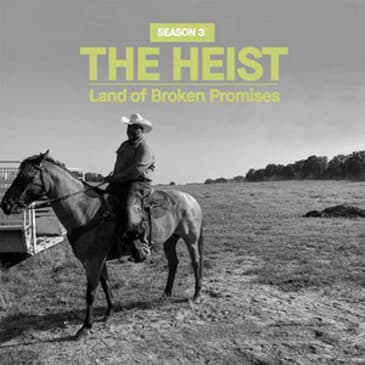
Surviving as a rancher is hard for lots of reasons: land has gotten more expensive, corporate farms have gotten more powerful and put pressure on small ranches to expand their operations to stay in business, inflation has driven up the prices of feed and supplies… But for Nate, and for Black ranchers and farmers across the country, ranching is also hard because the USDA, the government agency that they’re supposed to be able to turn to for support, instead makes it hard for them to get that support.
~~~~~~~~~~~~~~~~~~~~~~~~~~~~~
You can find Indie Drop-In at https://indiedropin.com
Help Indie Drop-In support indie creators by buying us a coffee!
https://buymeacoffee.com/indiedropin
Brands can advertise on Indie Drop-In using Patreon
https://patreon.com/indiedropin
Twitter: https://twitter.com/indiedropin
Instagram: https://instagram.com/indiedropin
Facebook: https://facebook.com/indiedropin
Any advertising found in this episode is inserted by Indie Drop-In and not endorsed by the Creator.
If you would like to have your show featured, go to http://indiedropin.com/creators
~~~~~~
]]>
[00:00:00] Listener discretion is advised.
[00:00:02] Hello and welcome to True Crime, the podcast that helps you find new emerging and undiscovered
[00:00:08] true crime podcasts.
[00:00:09] I'm Greg, the host and curator of True Crime.
[00:00:13] Today's episode is from The Heist.
[00:00:16] The Heist is an award-winning podcast focusing on the history of government discrimination
[00:00:21] against Black farmers.
[00:00:23] If you like today's episode, make sure to check out the episode description for links
[00:00:27] to subscribe. sleeve denim button-down, wranglers, work boots, and brown leather caps. Oh, it's already getting sticky. This part of eastern Oklahoma is where the South meets the mythic Western frontier. And Nate tells us we're right by an important historical marker. See these cows on the hill here? Just on the side of the road. That's the Georgia line.
[00:01:43] The Georgia Line is an area where Black migrants from the Deep South settled. I'm getting the maids. Each cow moves through to the end where its head gets locked in so it can't move. Then Nate vaccinates it with a massive, massive syringe. And Nate's eldest son puts a deworming paste, a white watery liquid in its mouth before setting it loose.
[00:03:00] Oh, and the mouth looks so nice.
[00:03:04] Everybody has a role in the work,
[00:03:06] which Nate reminds the kids
[00:03:07] when they sneak off to tell somebody something. That's just kind of the cowboy way. Nate talks about the cowboy way a lot. Sure, it's about making hard work more fun, but it's also more serious than that. It's a common creed in this part of the country, a kind of morality, a way of living life,
[00:04:21] being connected to the land, to nature,
[00:04:24] and to the ancestors who of Chile or Colombia. I started reporting on rural issues five years ago which led me to writing about agriculture. I grew up in rural America but I'm not a farm kid. So it's only through my reporting I learned about the long
[00:05:42] documented history of government discrimination against black farmers and it, but I started to wonder whether it's still going on today. That led me to a quest for data from the USDA that could help us see how the department is treating Black farmers. And it led me to Nate Bradford. His story is both extraordinary and ordinary. A story about how
[00:07:00] Nate went to the USDA for help, but instead met obstacle after obstacle, nearly killing his in whatever shade they can find, desperate to avoid the sun. There are horses here and there and lots of farmhouses. Some look abandoned and others look brand new. We see a sign with Nate to dress on it and the letter B for Bradford. His house is at the end of a winding gravel driveway. Nate's house is a
[00:08:21] really neat, thoughtfully decorated farmhouse. There morning. We were chasing cows, working cows, moving cows. Today, he's relatively well rested and eager. Y'all had to come in here and have a seat here. Water? Yes, please. He carefully takes off his work boots once we step inside
[00:09:43] and walks us into his dining room,
[00:09:45] which has warm maroon walls and a maple table Yeah, what do you want? What's your goal? Man, my goal is to be a full-time rancher, but my goal is to get the message out there. There's a lot of people going out of business right now. Nate grew up in Bole, a black town with a long history of agriculture.
[00:11:02] He's part of a distinct club, but you know, I don't really I'm going to look at this deal with a whole other set of glasses.
[00:13:42] I don't want to lose my family. And you know, I want to lose no more friends by being buried so ranchers have been losing land and wealth at such a devastating pace. The first big force is the transformation of the American cattle industry. The U.S. is the world's largest producer of beef, but many smaller ranchers have been squeezed out by four companies that control most of the slaughterhouses that ranchers
[00:15:00] sell to.
[00:15:03] Ranchers used to be able to this episode of The Heist. All right, so, here's our property. It's 160 acres. We built this in 2003.
[00:16:20] To give us a sense of everything he's added to his operation, Nate's walking us around G-Line.
[00:16:25] Here on G-Line Ranch, with all that it's a place open 24 seven. So there's something to do right here all the time. But selling hay and raising, breeding and selling cattle, it hasn't been enough to make Q-line consistently profitable. The money videos of life as a rancher, getting a cow's head unstuck from a hayring, and joking about buying feed during a drought, dancing with his kids at the corral, cutting off a cow's ingrown horn. That one has over 4 million views.
[00:19:02] I use what's called an OB cable, used when he realized there was nobody else doing it nearby. Hey, Dad, they don't have anywhere for deer processing.
[00:20:22] I think we need to get a deer processing,
[00:20:25] go on here, what can you do?
[00:21:24] Despite all that, Nate's dream lives on. He still imagines what his life would look like if one day all that work made
[00:21:29] the ranch really successful and all the labor wasn't just on him and his family.
[00:21:35] I know I have this house here, but I would like to cross this creek and
[00:21:40] go to the backside and build a new house on top of the hill back there and
[00:22:45] winters and brutal storms. The US Department of Agriculture is supposed to help people with that and much more. But for Nate and many other black farmers
[00:22:51] and ranchers, getting the help they need from the USTA has become another battle.
[00:22:56] More after the break. Often it requires a loan. And if you're a rancher or farmer, you may not be able to borrow from a regular bank. Most don't have an agricultural lending department. Or they might see it as too risky if you have a low credit score or little experience. Or because agriculture is so unpredictable.
[00:24:22] Instead, you go to the part three months to precondition them and Allow you to sell at a higher market So now you're looking in the situation like well, I'm short. Well The cow ain't gonna have another baby till next year Loan officers are trained to understand a situation like that and to respond with flexibility and support
[00:25:46] But the response often depends on the office and its leadership It took two years, but in 2000, Nate was approved for an FSA loan to buy cattle. He then got another loan to buy land. But in the long run, those loans would threaten his business, his land, and his home. I cannot say this.
[00:27:00] So it's kind of like the farm service agency is kind of like you got this got this molester In 1910, Black farmers held between 16 and 19 million acres of farmland. But according to the latest census of agriculture, in 2017, they owned just over 2.5 million acres of active farmland. That's around an 85% decrease.
[00:28:22] As Nate struggled to hold onto his land, he's also of a very particular kind of the cowboy way, one that he thinks is worth preserving. We do a lot of things in the United States. We don't shoot the American eagle. We don't kill it. We don't, you know, stuff that's about to be extinct,
[00:29:44] those animals, we save them.
[00:29:46] All I'm saying is we save a lot of stuff in the United States. Keshell Williams, Dan O'Donnell, McNellie Torres, Matt Duranzo, Jamie Smith-Hopkins, Lisa Yannick Litwiller, Ashley Clark, Vanessa Lee, Charlie Dodge, and Janine Jones. Our fact checker is Peter Newbit-Smith.
[00:31:01] This episode was mixed by Louis from Story Art.
[00:31:04] And this podcast was produced in partnership with the McGraw Center for Business Journalism