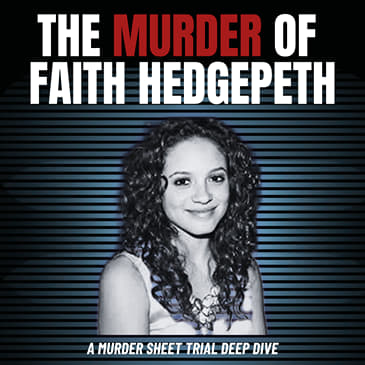
Miguel Enrique Salguero-Olivares is on trial for the 2012 murder of Faith Hedgepeth in North Carolina.
Order our book on Delphi here: https://bookshop.org/p/books/shadow-of-the-bridge-the-delphi-murders-and-the-dark-side-of-the-american-heartland-aine-cain/21866881?ean=9781639369232
Or here: https://www.simonandschuster.com/books/Shadow-of-the-Bridge/Aine-Cain/9781639369232
Or here: https://www.amazon.com/Shadow-Bridge-Murders-American-Heartland/dp/1639369236
Join our Patreon here! https://www.patreon.com/c/murdersheet
Support The Murder Sheet by buying a t-shirt here: https://www.murdersheetshop.com/
Send tips to murdersheet@gmail.com.
The Murder Sheet is a production of Mystery Sheet LLC.
See Privacy Policy at https://art19.com/privacy and California Privacy Notice at https://art19.com/privacy#do-not-sell-my-info.
[00:00:00] [SPEAKER_00] I am in love with Miracle Bomb from our new sponsor, Jones Road Beauty. Now, let's be clear, I'm not the biggest makeup wearer in the world. Sometimes I skip wearing makeup because it just doesn't feel good. It's too cakey, it looks bad or off, and sometimes I'm just in way too much of a rush to apply it well. But when I put on my Miracle Bomb, it looks natural, fresh, effortless. I put it on and I could head out to dinner with friends or a little date night with Kevin, or we could go to court. I love how lightweight it feels and I love that it gives me a bit of a glow.
[00:00:28] [SPEAKER_00] It's just this kind of clean, natural look that I love. I adore how it enhances my skin instead of just hiding it. Also for me, it's just so convenient. I could put it on really fast. Like one day after we were super busy with the podcast, Kevin and I went out for dinner in a movie, the new MST3K reboot. So even though I didn't have a lot of time, I put it on and loved the way I looked. It took about like five minutes at most. Also, clean beauty is a must for me.
[00:00:51] [SPEAKER_01] This formula is packed with ingredients that love your skin with no phthalates, sulfates or BPA.
[00:00:58] [SPEAKER_00] No clogging, no clumping, just convenient beauty. Miracle Bomb requires no brushes. Use it as a highlighter, a bronzer, a blush, lip tint, whatever you want. They'll have you glowing up in 60 seconds. They did for me. Oh, and definitely try their minimalist defining mascara too. The formula leaves your lashes so soft and feathery, no clumps, and it's the most natural looking definition.
[00:01:18] [SPEAKER_00] Modern day makeup that's clean, strategic and multifunctional for effortless routines. For a limited time, our listeners are getting a free full sized mascara on their first purchase when they use code M sheet at checkout. Just head to jonesroadbeauty.com and use code M sheet at checkout. After you purchase, they will ask you where you heard about them. Please support our show and tell them our show sent you.
[00:01:41] [SPEAKER_00] I'm Anya and today on the murder sheet, we're going to be delving into the ninth day of an ongoing murder trial in North Carolina. And this day also marks the end of the state's case in chief. Content warning. This episode contains discussion of rape and murder.
[00:01:58] [SPEAKER_00] Let's go back to why we're all here. Let's go back to September 7th, 2012, when 19 year old UNC Chapel Hill student Faith Hedgepeth was discovered brutally murdered in an apartment on the border of Chapel Hill and Durham County, North Carolina.
[00:02:17] [SPEAKER_00] This young woman had her whole life ahead of her. Was a very special, nice young lady who really, I think, made other people feel seen and connected and was very much all about community and her family and seemed like a bright presence in life. But unfortunately, she was just brutally murdered and her life was snuffed out. This case kind of remained somewhat infamous and something that was covered on different true crime podcasts over the years. Nothing happened.
[00:02:47] [SPEAKER_00] They seemingly had DNA at some point. It became clear, I think, or the possibility existed that they had DNA, but somehow it wasn't getting solved. Then cut to September 16th, 2021. That is when Miguel Enrique Salguero Olivares, a former Durham County resident, was arrested and charged with first-degree murders. Finally, maybe there was an opportunity to get answers. There's been an ongoing trial against him in Durham County.
[00:03:15] [SPEAKER_00] His legal team is led by James Rainsford and also consists of Christopher Barnes and Jason Murphy. The prosecutors are Lisa Coltrane, a special state prosecutor specializing in arson and homicide. Angela Garcia-Lamarca, who is a Durham County assistant district attorney, gave the opening statement. Brooke Stone, the Durham County assistant district attorney. And of course, the judge is the Honorable Keith O. Gregory, the Superior Court Judge presiding.
[00:03:41] [SPEAKER_00] So today we're going to get into the ninth day of trial. And this is the final day we're going to hear from the state. This is the last day of the state's case in chief. They have arrested and we will be going forward then with the defense's case in chief. So let's get into it. My name is Anya Kane. I'm a journalist.
[00:04:02] [SPEAKER_01] And I'm Kevin Greenlee. I'm an attorney. And this is The Murder Sheet. We're a true crime podcast focused on original reporting, interviews and deep dives into murder cases. We're The Murder Sheet.
[00:04:14] [SPEAKER_00] And this is the murder of Faith Hedgepeth, the trial of Miguel Enrique Salguero Olivares, day nine. The state rests.
[00:04:23] [SPEAKER_00] So I wanted to start out with a note on Faith and who she was because today is the last day.
[00:05:13] [SPEAKER_00] In a way, prosecutors are not supposed to represent law enforcement. They're not supposed to represent the victims' families. In a way, perhaps the person they might speak for the most in some capacity, especially when the victims are no longer here with us and there's no surviving victim, is the murder victim here. You know, they are trying to do what they see as getting justice for Faith, who is no longer here and didn't get to enjoy her life.
[00:05:44] [SPEAKER_00] So in a way, like now we're not going to hear from that side any more aside from they'll get to do the cross examinations like the defense has been doing this whole time. But there's going to be a different feel. When you conceptualize of a successful state's case-in-chief sort of run, Kevin, what does that look like for you?
[00:06:08] [SPEAKER_01] Well, it's very complicated.
[00:06:12] [SPEAKER_00] Okay. Well, what are some things you like to see that make you think this was a pretty good case for the state?
[00:06:18] [SPEAKER_01] Well, obviously, I think a lot of people want and expect to see DNA evidence. Obviously, you don't need DNA evidence to get a conviction. But when you do have DNA evidence, it at the very least is evidence of a solid connection between the accused person and the crime.
[00:06:41] [SPEAKER_01] So when I see the DNA evidence in this case and I see some of the other evidence in this case, especially some of the evidence about what she was like as a person. And when I look at that evidence, it doesn't seem like there is an explanation for her to be in contact with this person in such a way that the DNA evidence would be left that is consistent with his innocence.
[00:07:07] [SPEAKER_00] Yeah, I agree. I think the evidence in this case is extremely powerful. Extremely powerful. Now, something happened today in day nine, rather, that's yesterday that made me feel like they fumbled a little bit on their last day. I thought there was a mistake made that really stood out to me that I think I'm going to just say that for now. We can talk about what it is when we get to it chronologically.
[00:07:33] [SPEAKER_01] You got me curious.
[00:07:34] [SPEAKER_00] And I will hold off on telling you how important I think this is and what kind of impact it might have, because maybe we can all kind of assess together what that might be and what that looked like. But I will I will give you a little forecast that there was something that I was like, OK. So we resumed testimony with Justin Heinrich. He is the special agent in charge of the special operations unit for the North Carolina State Bureau of Investigation.
[00:08:04] [SPEAKER_00] And he became the lead case agent on this after the one year anniversary of Faith's murder. It had gone unsolved up at that point. I guess it makes sense that Chapel Hill would sort of ask the Bureau of Investigation to sort of come in and say, can you look at it and maybe put some fresh eyes onto it? Chapel Hill is not a huge police department and it's not a place where a lot of murders happen. So that makes sense.
[00:08:32] [SPEAKER_00] Now, we didn't get to hear from him testifying right away, though, because the defense kind of went into a whole thing with the judge where they were asking for a lot of his testimony to be stricken. And they needed to go back and forth over that. Basically, this testimony where he was giving his opinion. They were asking for a curative instruction and objecting to his specific statements about how Karina Rosario, Faith Hedgepeth's roommate, about how her statements were remarkably consistent.
[00:09:02] [SPEAKER_00] That was something he testified to in terms of, like, why did you find her credible? Well, her statements, the big picture, very consistent. She was very cooperative. She would help us. She would talk to us no matter what was going on. She stayed in touch. And the defense said that should be struck. And also, when he testified that it was apparent that this was not just a homicide, but also a rape, they didn't like that at all. They're saying, no, it's not obvious.
[00:09:30] [SPEAKER_00] And now that statement had been struck, but they were saying, like, we need to do even more about that. And basically, what they said, that invades the province of the jury. The jury should be allowed to say, OK, I think it was a rape or I don't think it was a rape based on the evidence they heard. Him putting his thumb on the scale is bad, according to the defense. And they also really didn't like when he said, if we could identify whoever deposited the DNA into Faith Hedgepeth's body, we found our person.
[00:09:58] [SPEAKER_00] And they're saying it's prejudicial. And when you say we, that pronoun indicates that you're speaking for all of law enforcement. So they were very upset about a lot of that. And what do you think about those arguments?
[00:10:13] [SPEAKER_01] It's just the sort of thing you'd expect to happen. I don't find it particularly convincing, but it's always worth making those kinds of arguments.
[00:10:21] [SPEAKER_00] So, yeah, there was back and forth and they had a whole memorandum of law. They wanted that put into the record. And the prosecution came back and they said, OK, like, we don't even agree with your interpretation of this case law. But even beyond that, that's not at all what Agent Heinrich did here. He was saying that her testimony was consistent. That's his opinion. And also it's corroborative. And he's not vouching for her statements.
[00:10:51] [SPEAKER_00] He's just saying, like, in my investigative experience, this tends to be the case. And this is how I base my opinion. And that's completely permitted based on the case law. You know, as for the defense's contention that the sexual assault nurse examiner, who's like an expert in that, said that she couldn't say that there was definitively a sexual assault based on injuries.
[00:11:10] [SPEAKER_00] You know, that, like, there's also other things like Faith's shorts being ripped off and her being, like, left naked and with her bra pulled up and her tampon out and deposited on the floor instead of in a waste receptacle. And, you know, signs of this kind of violent sexual act. And, yeah.
[00:11:37] [SPEAKER_00] So they were saying, like, you know, that's kind of a that's kind of an inescapable conclusion based on, like, the crime scene photographs that he would have reviewed. And so what the courts I mean, what what the judge said was ultimately. You know, he never said, like, Karina Rosario was telling the truth, just that her in his view, her statements were consistent. And that's based on his training and experience. And, you know, he was basing it off of something, saying that he believed a sexual assault took place.
[00:12:05] [SPEAKER_00] And these were things that maybe guided his investigation. Now, he said, like, we're going to strike the whole we found our person statement and maybe we'll give the curative instruction of we found the person responsible for what happened. But, yeah, they weren't going to give the defense everything they wanted there. Which I think seems fair. I mean, I don't know there.
[00:12:28] [SPEAKER_00] I really get it because, like, there is a difference between, like, common sense and what is legally permissible. They're charging the defendant with this rape murder. So from the defense's perspective, emphasizing, hey, there were no injuries to her genitals and that leaves it ambiguous because that means there could have been a rape, but there also could not have been a rape. Like, that makes sense.
[00:12:57] [SPEAKER_00] But I think, like, especially when I talk to women about this, they're like, okay. She's found, like, that when you're on your period, okay, you're not going to sleep naked. You know, I mean, I don't, like, like, that doesn't make any sense.
[00:13:13] [SPEAKER_01] There's a lot of things like that that just seem to defy common sense.
[00:13:17] [SPEAKER_00] You're not going to leave a tampon on the ground ever. Like, or pull it out of your body. It's like, and then we learn about Faith and we learn, okay, she didn't want to have sex with men on her period. That wasn't something she wanted to do. That was something that she really liked some of these guys and, like, she would have these sexual partners and they'd have good connections. But she didn't want to do that. That wasn't what she was doing.
[00:13:43] [SPEAKER_00] So then we're having to believe someone came in without being someone in her life, someone she knew or trusted. And then she was left in that condition, naked with all her clothes disarranged and a very disrespectful and kind of, when that wasn't how she would be around the apartment ever. And her tampon's on the ground and she just happens to get beaten to death the same night that that sexual contact takes place.
[00:14:09] [SPEAKER_00] It just seems like, it's like, it gets really hard to believe that she was not raped. And that's the common sense side. But we can still appreciate that the defense has a job to do and that they are trying their best to defend their client zealously. And it might seem to us like that seems really weird or, like, that's totally out there to say. But, like, that's their job. That's their job. And we got to respect that because I think that's important for them to force the state to prove the case.
[00:14:38] [SPEAKER_00] So anyways, you know, the jury comes in. They start getting into the questioning. Heinrich testified about talking to Karina about going to the Thrill and, like, just taking him through the whole timeline once more. He said one challenge to the investigation was finding all these people a year later who might be people who might have been witnesses or people who might know something.
[00:15:06] [SPEAKER_00] And there was, you know, and then he also went back to some of these transcripts done about the conversation between the defendant and his mother, which we went into, that he sort of recited in the last episode of, like, okay, what does that look like?
[00:15:55] [SPEAKER_00] He said,
[00:17:32] [SPEAKER_00] Plus, I don't know what magic or sorcery they're doing for this, but the more we wash them, the softer they get. I've never had that before. Seriously. Check them out. You're going to melt away. You're going to take your bedtime routine to the max. Bull & Branch sheets are the official pick of the murder sheets from here on out.
[00:17:49] [SPEAKER_01] Upgrade your sleep with Bull & Branch. Get 15% off your first order plus free shipping at bullenbranch.com slash msheet with code msheet. That's Bullen Branch, B-O-L-L-A-N-D, branch.com slash msheet. Code msheet to unlock 15% off. Exclusions apply.
[00:18:07] [SPEAKER_00] We love looking good and saving money. So we love our wonderful sponsor, Quince. The clothes they make are comfortable, affordable, and they don't go out of style. They're those wardrobe staples you'll reach for again and again. We certainly do.
[00:18:20] [SPEAKER_01] I recently got a pearl snap denim western shirt and denim blue that I wear all the time now. For everyday and for fancier events and get-togethers, it's breathable and comfortable, which is a huge deal for me. And I know as the weather cools, I'll be returning to my Quince sweaters. Namely, my Australian merino wool cable crewneck sweater and my Mongolian cashmere crewneck sweater. Those are so soft and so perfect for the fall. Their Mongolian cashmere sweaters start at just $60. Check them out.
[00:18:50] [SPEAKER_00] Seriously, get them and we can all match. I love my 100% European linen fit and flare midi dress in chilly red and navy blue. I got two of them because I love them so much. The fit is so good. I think they're so cute and I've gotten a lot of compliments wearing them, so love that. And as Kevin said, I can't wait until it's a bit colder out so I can break out my Mongolian cashmere sweaters. That's the great thing about Quince, though. You want to wear these pieces again and again.
[00:19:14] [SPEAKER_00] These are classic pieces and you're going to want to get even more because these are 50 to 80% less than similar brands because they cut out the middlemen. Refresh your wardrobe without breaking the budget.
[00:19:25] [SPEAKER_01] Find your next fall favorites at Quince. Download the Quince app for app-exclusive offers or go to quince.com. Get free shipping on your order and 365-day returns. Now available in Canada and the UK, too. And when Quince asks where you heard about them, let them know it was the murder sheet. It is the best way to support the show. We'd like to give a big thank you to Vinted, the sponsor of this episode.
[00:19:49] [SPEAKER_00] For those of you who haven't seen backgrounds of our lives, the clutter has gotten out of hand at our house. So I've decided to make an effort to do some serious cleaning. One of the places I'm starting is in our bedroom closet. I can't believe all the clothes I had in there that I'd probably frankly never wear again. They were taking up a lot of space. But I didn't want to just be wasteful and throw them away. That didn't seem right, and they have a lot of life in them.
[00:20:11] [SPEAKER_01] That's when we found out about Vinted, a great way to turn the clothes in our closet into money.
[00:20:17] [SPEAKER_00] And also clear up closet space for new clothes.
[00:20:21] [SPEAKER_01] Vinted is a second-hand market app that makes it easy for everyday sellers like us to sell our pre-loved fashion items. I love that this app is free to download and there are no seller fees. That means we get to keep everything we earn.
[00:20:37] [SPEAKER_00] Vinted makes it so easy to list items. They even help you after an item sells by creating prepaid shipping labels. It couldn't be simpler. And that just makes me want to list more and more items. It makes me feel so much better to have a less cluttered closet.
[00:20:52] [SPEAKER_01] And these days it also helps to be able to earn some extra money, especially when Vinted makes it so easy. Vinted. That's Vinted. V-I-N-T-E-D. See what's hiding in your closet. You might be surprised how much you can earn with Vinted. Download the Vinted app for free to start listing with no seller fees.
[00:21:13] [SPEAKER_00] Okay, now we're going to get something where, you remember when I said they fumbled?
[00:21:17] [SPEAKER_01] Yes, tell us about that.
[00:21:18] [SPEAKER_00] They fumbled the ball. I'm going to set it up. I don't know if I'll, like, reveal everything that happened here, because we might want to build to that, but let's keep the fumbling in mind. So they started talking about handwriting. There was a note scrawled on a fast food takeout bag at the scene. It said in very scratchy block letters, I'm not stupid, bitch, jealous.
[00:21:46] [SPEAKER_00] It was believed to have been left by the killer. In my view, this is just my personal view. It's not based on the testimony. That is not, first of all, we see other cases where killers do that. I think it's usually more about shocking people who find the scene rather than a specific message to the victim. That's just my take. And some of those notes that killers leave just don't really make a lot of sense, or they're kind of antithetical, you know, to, like, what you would expect. So, whatever.
[00:22:14] [SPEAKER_00] You have this situation where they find that. When I look at the handwriting, I think it's very scratchy. It doesn't look like someone's real handwriting. It's, like, all in block letters. And it's, like, I don't know. It just seems a bit childish. So it's, like, I could see it being someone has really bad handwriting like I do. My handwriting is so bad that when I take notes in court, people think I'm writing shorthand, and I'm not. It's just really bad handwriting.
[00:22:41] [SPEAKER_00] But then you also could have someone trying to disguise their handwriting or someone who's just writing on this crinkly paper bag and it's making their block letters look weirder than normal. So, like, there's, like, it... To me, handwriting's not, like, a super great or reliable piece of evidence. They previously, in the last episode, in the last day of testimony, Agent Heinrich brought up this picture they found that they sort of purported to be of the defendant's handwriting.
[00:23:11] [SPEAKER_00] Specifically, should we admit this handwriting by the defendant to compare to the white paper bag? The prosecutor wants to note the similarities. The judge is, like, I don't have to be a handwriting expert to let this in. And Special Agent Heinrich said, I'm not a handwriting expert, but all the letters are in caps. It was a picture of a note next to a stack of foreign currency. So, I mean, like, yeah, they were kind of, like, presenting it,
[00:23:41] [SPEAKER_00] you know, like it was something to compare it against to. But then today comes out at some point, oh, well, we actually, you know, it got my attention because it was not written in cursive. It was all caps. Besides, the lettering was consistent. I couldn't tell you who actually wrote it, though. And I just can tell you it was saved on the defendant's computer, not that he was the author of it. So at that point, my hackles are up. Like, wait, what? That's not how this was portrayed yesterday.
[00:24:11] [SPEAKER_00] Well, keep that in mind, folks. Now, in fairness, we do get a moment where they do show something that is actually definitely from his handwriting. And we know that because we actually see him write it. They introduce a jail call that was video recorded between the defendant from February 14, 2023, and a woman, a young woman, who are talking.
[00:24:39] [SPEAKER_00] She is identified as Katie or Catherine Ellen. She basically calls into him. There's all this back and forth. She's getting very upset because she cannot hear him. And he's trying to make it work. He seems very excited to see her. But there's all this issue about not being able to hear. So he leaves for a while and returns the piece of paper and a pencil and writes down something to the effect of, give me your number. I'll call you.
[00:25:09] [SPEAKER_00] And so she proceeds to write down her number so that they can continue a conversation since the video service is not working for her. She's crying at certain points. And there's some reminiscence over going to a birthday party and her getting drunk. And they seem to be friends. And then later on, it comes out that she had been a student in 2013 at UNC.
[00:25:37] [SPEAKER_00] And they were friends. Now, interestingly, when this was going on, he was actually, the defendant at the defense table, was crying. So that struck me. He was like openly crying watching this video. So it came out that Miss Ellen actually died in 2024. That's why we're not hearing from her at all. And I'll note that I looked up her name. It's a bit of a distinctive name.
[00:26:07] [SPEAKER_00] Because I thought it was Ellen at first, but it was actually Ellen. And I found a Davidson local news article that talked about how in 2024, a 31-year-old named Catherine Ellen was found dead in Davidson County. And she had died in a suspected overdose death as a result of fentanyl.
[00:26:34] [SPEAKER_00] And it's actually far worse than that because she was not the only one dead. With her was her seven-month-old baby daughter who had died of dehydration as a result of her mother consuming fentanyl, dying and being unable to care for her for an extended period of time. So that's horrible.
[00:27:01] [SPEAKER_00] Ultimately, a person named Donta Williams was convicted on July 14, 2026 of death by distribution and involuntary manslaughter. And he was sentenced to 199 to 260 months in the North Carolina Department of Adult Correction. So that appears to be the same person as the, and certainly the same general year of death
[00:27:31] [SPEAKER_00] and same distinctive name and same age range if she graduated from UNC in about 2013. So yeah, it is, it's, or I don't know if she graduated in 2013, but certainly was in UNC in 2013. So I believe that is the same person. So that's horrible. We revisit the whole Karina Rosario thinking she had blood on her hands and going into that whole thing.
[00:28:01] [SPEAKER_00] And, you know, him saying she didn't, she just kind of has said, I don't know what that was. She can speculate that maybe she was drinking a lot of red alcohol and was vomiting. That may have been it. She may have thought it was blood and it wasn't. She also was spotting from an abortion. You know, who knows? But either way, I mean, her shorts didn't test positive for blood. There's no indication that she was covered in blood. So the defense on Cross brings up, well, you said that Faith tended to date African-American young men about her age.
[00:28:30] [SPEAKER_00] But we have something from a witness who said that she might have dated a Hispanic male. And the prosecutor kind of brings up, like, they think that this is irrelevant. And the person they're bringing up actually is someone named Eric Estrada, who worked at Red Robin with Faith. And he said that she dated someone who was Hispanic. And he, so basically the defense asks Heinrich about that. And he says, yeah, he,
[00:28:59] [SPEAKER_00] Estrada gave a bunch of information that was factually incorrect. So they didn't really go anywhere with that. Like, the people we confirmed who were her romantic partners, intimate partners, were African-American. So, like, that's what my testimony is. So, you know, like, something like that kind of seems to backfire on the defense a bit. It's like, oh, why didn't you rely on this unreliable person? Turns out Estrada's not even here anymore. He was deported ultimately. So, I mean, I don't know.
[00:29:25] [SPEAKER_00] So they also talk about, there's a lot of debate over why Brendan Edwards, who was the man who impregnated Karina Rosario, why he wasn't saved in Faith Hedgepeth's messages as a contact. I don't really get the point of why they were emphasizing that so much. But I, listen, I've been watching a lot of this trial. Maybe it just went over my head. But there's like, why, they're not in the contact list. Is there a difference between a name in the phone and a contact? Okay.
[00:29:55] [SPEAKER_00] At one point, I believe Faith got in touch with him. Like, oh, you need to be nice to Karina, essentially, and take care of her because she's really upset right now. There's discussion of all sorts of texts between different people that we've already heard from. So I'll kind of skip over some of that. There's reference to the neighbor of Karina and Faith's who lived underneath them, who heard multiple thumps around the time of the, you know, on the night of or on the early morning of.
[00:30:25] [SPEAKER_00] Basically said she heard three thumps. Why didn't Heinrich interview her as far as the defense is concerned? And he said that's just not really a key priority to us because we believe she actually heard the noises around the time when Karina Rosario and Faith Hedgepeth returned home from the thrill. If she's hearing three or four thumps between 3 and 4 a.m., that seems pretty close to when they might have been – I mean, they might have been returning home a little bit earlier than that, but it might have – like, you're depending on a witness in, like,
[00:30:52] [SPEAKER_00] the early morning hours to immediately know what time it is exactly and have, like, a perfect recollection of that. And they even – he even talked about on redirect at one point, I believe, said, like, the source of the thumping noises were coming from directly above this woman, this witness's head, and that would have been Faith's living room. We know that the attack happened in the bedroom based on the blood spatter.
[00:31:18] [SPEAKER_00] So, like, it's not necessarily clear that that is relevant. I mean, what do you think, Kevin?
[00:31:26] [SPEAKER_01] Yeah, I'm not sure that's really relevant. I agree with that.
[00:31:30] [SPEAKER_00] So, this is the fumble. I remember I mentioned that whole foreign currency picture with handwriting on a note, that whole thing.
[00:31:40] [SPEAKER_01] You did.
[00:31:42] [SPEAKER_00] That was a meme. That was a meme. That was not apparently – according to the defense, they said, you thought this was my client's handwriting, but that was, like, a widely circulated meme. It was saved – like, I have memes saved on my computer, or I might have, like, have a GIF that I used or whatever. You might have them on your phone or a screenshot of something.
[00:32:02] [SPEAKER_01] That's certainly a fumble. You told us – you would tell us how important you think it is.
[00:32:06] [SPEAKER_00] Well –
[00:32:07] [SPEAKER_01] To spill the beans. The tea.
[00:32:08] [SPEAKER_00] I mean, let's go – I mean, like, you know, the defense – I mean, the defense got it. Like, I was like, oh, dang. They must have just been salivating to bring this up. You know, he's saying – All I had was – it was a file on his computer. It was saved. I couldn't do a reverse image search because of, like, technical reasons. And there were certain characteristics that just looked consistent with the note found at the murder scene. I'm not an expert.
[00:32:36] [SPEAKER_00] You know, we were looking for samples of your client's writing, but I'm glad I could correct it. So, sorry about – you know, kind of like that. And we ultimately did get a handwriting sample because we mentioned the whole jail call where he writes something down. So, I think this made them look really sloppy. I think, you know, it made the state as a whole look kind of sloppy because why are you trying to introduce a meme? You know, like, it was a mistake. It was a fumble.
[00:33:06] [SPEAKER_00] I don't think it matters. Like, I'm just – I think something can be something that's like, oh, come on, guys. And then at the same time – listen, here's my thinking. If the facts were totally different and there wasn't a mountain of forensic evidence, this might be something that would harm the jury's faith in the investigation quality to the extent that they might be concerned. Okay, well, what else are you trying to bring in that may not actually be evidence?
[00:33:33] [SPEAKER_00] But as things stand, I don't – I don't think that. I think investigators are human and they're capable of making mistakes.
[00:33:42] [SPEAKER_01] Yeah, one thing we often talk about is that any endeavor done by human beings is going to be imperfect because all human beings are, unfortunately, imperfect. So the question is not, oh, was this perfect? Did they make mistakes? The question is, does this mistake affect the integrity of the investigation?
[00:34:07] [SPEAKER_01] And if this was – you could imagine a situation where something like this could be a sign of a deeper problem, of a tendency to try to almost manufacture a case against someone, or this particular bit of evidence is too good to check. But when we look at this thing in whole, when we look at it in the context of the entire investigation and the overwhelming amount of evidence against this man,
[00:34:35] [SPEAKER_01] I tend to agree with you that it is ultimately insignificant, even though it is also admittedly more than a little embarrassing.
[00:34:43] [SPEAKER_00] It's embarrassing. I don't think it means that Special Agent Heinrich is a bad investigator or that he's even to blame. I mean, I think the – I mean, investigatively, I'm sure there's a lot of people who, like, found this and didn't really vet it as much as maybe it should have been vetted. I think, you know, it being a foreign language meme, it wouldn't be something that everyone would immediately recognize. That might be a cultural boundary,
[00:35:08] [SPEAKER_00] maybe getting someone who is well-versed in, you know, basically cultures and, you know, Guatemalan culture, Central American. Like, what might be the memes down there? Like, that would be relevant to know. But to me, it's one of those things. It's embarrassing. The defense definitely dunked on them, and we got to give the defense credit for that, I think. And, you know, did a masterful job of being like, this is a meme. What are we doing here?
[00:35:36] [SPEAKER_00] But I don't think that it's the end-all be-all. But I think it's definitely something that, again, I'm sure the defense was like, that's a meme. Like, let's go, you know? Yeah, I don't think it's that important when we're comparing it to the DNA. The defense is really going to have to, like, come up with a really good explanation of that, which their client has dug them a deeper hole by denying even knowing her. Because why would you deny that when the DNA tells us differently?
[00:36:03] [SPEAKER_00] And again, getting a meme wrong and interpreting this wrong does not make anyone corrupt. It does not make anyone trying to frame him. It's a mistake. I'm glad it was corrected, because nonsense like that does not belong in the record. You know? And I would hope that this would prompt some soul-searching from the prosecution and the police to really make sure something like this doesn't happen again. Because we don't want to convict people based on memes. That's not good.
[00:36:34] [SPEAKER_00] But at the same time, it just, it's not, in a different case, maybe this would be rattling. I don't, I don't think it is. But I think it does deserve to, you know, be highlighted as like, hey, these are human beings, they make mistakes, and we got to make sure that those mistakes don't hinder the cause of justice ever. There's a lot of discussion about, like, things that went wrong in the investigation. Why did you not look at this? Why didn't you look at these people more? Why didn't you get this footage? Kind of your standard stuff.
[00:37:01] [SPEAKER_00] And then there was also kind of on the redirect side of like, well, you know, by the time you, like, why weren't you looking more at her sexual partners? And all these other men in the case, well, at that point we had offender DNA. So, you know, that kind of narrows it down usually. Now, we ended up, and to wrap up, the defense asked the state to dismiss the indictment, arguing that, hey, the state didn't even prove the elements of the charges.
[00:37:31] [SPEAKER_00] Is that a shocking twist? Because I think reporters, I'm just, I'm not even calling anyone out here. I've just seen this in other cases. Reporters are like, the defense asked the judge to throw out the case. It's all going down, folks.
[00:37:49] [SPEAKER_01] That's not shocking at all. It's, you know, it happens a lot. Batten down the hedges. I wouldn't necessarily say it's routine, but it's close to routine. It's not a big deal. I think it's very close to routine. It's very close to routine. Whatever you got to lose, you know, go ahead and ask.
[00:38:06] [SPEAKER_00] If the state bungles the case, at least it could work, you know? I mean, yeah, we've seen it happen.
[00:38:13] [SPEAKER_01] We've seen it happen. It's not a big deal. I wouldn't read too much into it.
[00:38:19] [SPEAKER_00] Yeah, I'll go into that. So let's look at their reasoning, though. Well, let's actually look at their reasoning. So, and this is outside the presence of the jury, of course, they argue, hey, there's a burglary charge. No sign of forced entry, no evidence that a weapon was brought into the space and, you know, that they indicated any sort of intent, like a gun, a knife, whatever. The state hasn't even really put forward a timeline of, like, when exactly do they think
[00:38:48] [SPEAKER_00] our client broke in or got in. And more than that, on the rape side of things, there's no evidence of injuries to the genitals, of the body of the victim. There's no, the testimony from the medical examiner, examiner, like, basically said, like, she didn't do cleansing of the body before taking the swabs. Which, like, okay. And then, you know, let's basically throw out the whole indictment.
[00:39:17] [SPEAKER_00] Get it out of here. And, you know, and what the judge responds is, like, listen, in this, like, I take the, I take, I look at this evidence and I have to look at it based on the standard in the light most favorable to the state. That might surprise people because we're always hearing about innocent until proven guilty, right?
[00:39:36] [SPEAKER_01] Yeah.
[00:39:36] [SPEAKER_00] But when it comes to the actual indictment, the state gets the edge, right?
[00:39:40] [SPEAKER_01] Yes.
[00:39:41] [SPEAKER_00] And so what he's noting is, like, like, we're hearing from Karina Rosario that she closed the door on the way out. Even if it's not locked, and it sounds like she and Faith were not locking the door, that's still burglary. Like, if you're going in, like, that's still a problem. And, you know, that there's a, you know, it can survive that. And, you know, the presence of semen and sperm in the vaginal and rectal swabs,
[00:40:09] [SPEAKER_00] you know, that shows some kind of sexual contact, some kind of sexual penetration. You know, the bottle being used to bludgeon her, you know, all of this is relevant. So the judge denied the defense's motion to throw the whole thing out. So, yeah. The defense is going to start calling witnesses soon.
[00:40:33] [SPEAKER_01] That will be interesting. We've both been very curious to see what the defense's case is going to be. Because so far, as we've indicated, the evidence against their client seems overwhelming. But we have not heard the defense's spin on it. And maybe they can come up with some sort of explanation that could make things go a little bit better for their client. Who knows?
[00:41:02] [SPEAKER_01] Who knows what their arguments are going to be, what they're going to offer. Important to keep in mind, of course, they do not need to prove that their client is innocent. They just have to raise a reasonable doubt that he is guilty.
[00:41:19] [SPEAKER_00] That's exactly right. They don't have to solve the case. They just have to tear down the state's case. It's sort of like if you're in a sandcastle competition and one side, they don't have to, they don't have to build their own sandcastle. They can just knock down the other guy's sandcastle. But it's hard to do. It can be hard to do because sometimes people, the jury might subtly want to see another sandcastle. So that can make people a little biased against the defense because they want someone to blame. It can be difficult.
[00:41:49] [SPEAKER_00] So it's not as easy as I made it sound with that sandcastle metaphor. Apologies to the defense attorneys. I know you have a very hard job. And I will say one note that's interesting. There's going to, we're not going to necessarily jump right into the defense's witnesses. There's actually going to be a colloquy. I hope I'm saying that right. Not humiliating myself on this recording. But there's going to be a court's colloquy of the defendant. I looked that up because I didn't know what that was. And apparently that's usually not held
[00:42:18] [SPEAKER_00] in front of the jury. It's usually like some kind of on the record sort of situation involving the judge, the defendant, attorneys. And it's like a, you know, they're trying to, I guess, basically make sure everyone understands everything. And I don't, often it's associated with pleas. But I don't necessarily think that's what's happening. But I mean, I don't think he's going to plea.
[00:42:48] [SPEAKER_00] Maybe there can be other, maybe I misunderstood something or maybe there can be another type of thing. So we'll find out. But thank you all so much for listening.
[00:42:56] [SPEAKER_01] Thanks so much for listening to the Murder Sheet. If you have a tip concerning one of the cases we cover, please email us at murdersheet at gmail dot com. If you have actionable information about an unsolved crime, please report it to the appropriate authorities.
[00:43:16] [SPEAKER_00] If you're interested in joining our Patreon, that's available at www.patreon.com slash murdersheet. If you want to tip us a bit of money for records requests, you can do so at www.buymeacoffee.com slash murdersheet. We very much appreciate any support.
[00:43:40] [SPEAKER_01] Special thanks to Kevin Tyler Greenlee, who composed the music for the Murder Sheet, and who you can find on the web at kevintg.com
[00:43:49] [SPEAKER_00] If you're looking to talk with other listeners about a case we've covered, you can join the Murder Sheet discussion group on Facebook. We mostly focus our time on research and reporting, so we're not on social media much. We do try to check our email account, but we ask for patience, as we often receive a lot of messages. Thanks again for listening.